
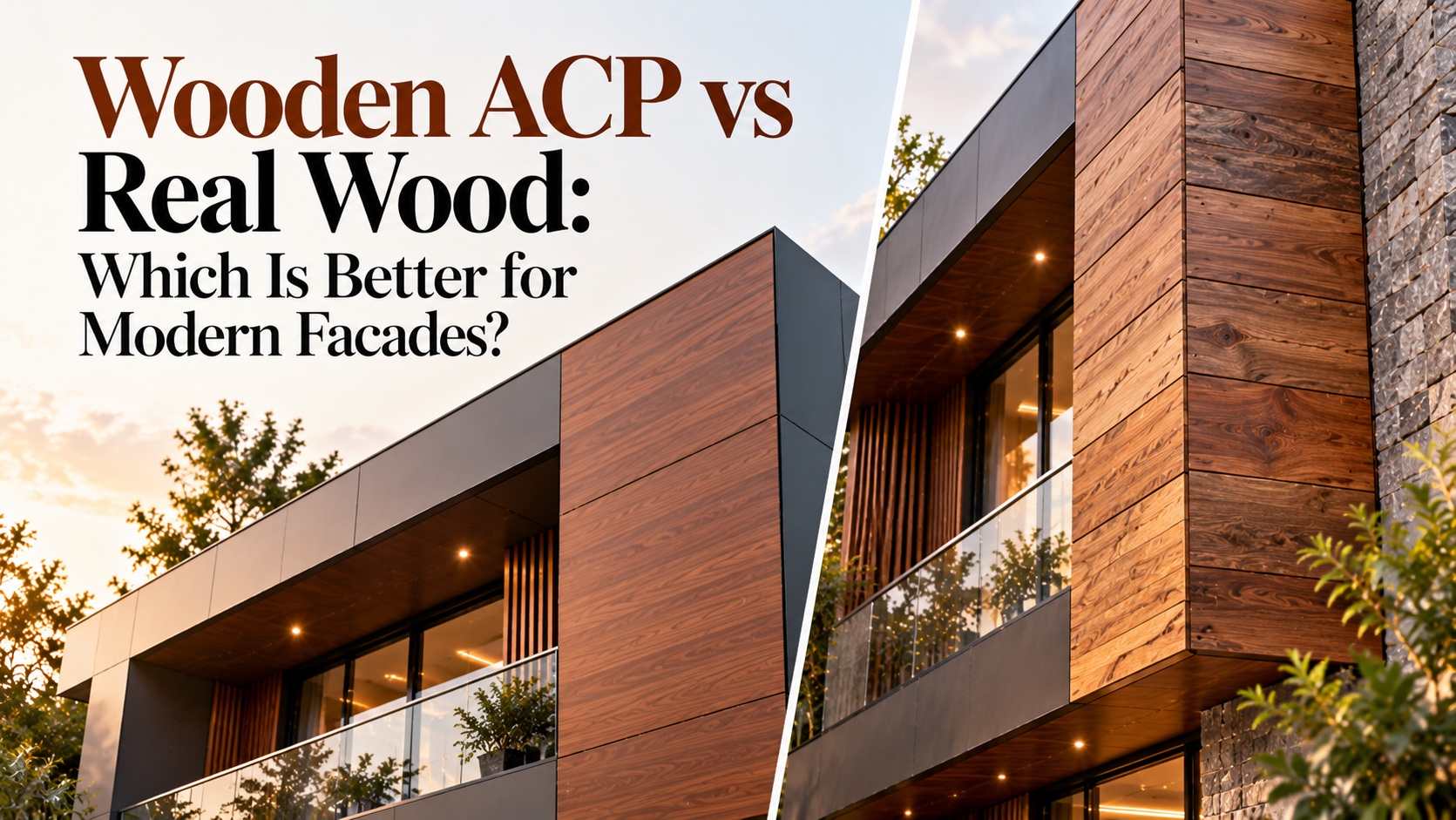
Wood has always been associated with warmth, elegance, and natural beauty. That is why wooden façades continue to be popular for modern homes, villas, offices, resorts, and commercial buildings. However, natural wood also comes with practical challenges such as regular maintenance, moisture exposure, warping, fading, and pest-related concerns.
Wooden ACP sheets offer another way to achieve the same wood-inspired appearance while using an aluminium composite panel designed for modern exterior applications. The key question is: Wooden ACP vs real wood — which is better for a modern facade?
The answer depends on the project’s design goals, maintenance expectations, budget, climate, and material preferences. For many contemporary facades, wooden ACP can provide an attractive balance between appearance, durability, and easier maintenance.
What Is a Wooden ACP?
Wooden ACP, or wooden Aluminium Composite Panel, is an ACP sheet manufactured with a wood-inspired decorative finish. The aluminium surface can be finished with patterns and textures that resemble materials such as teak, walnut, oak, mahogany, and other timber styles.
Unlike solid timber, wooden ACP does not rely on natural wood to create its appearance. This allows architects and homeowners to incorporate wood-inspired facades while using a lightweight cladding material.
Modern wood-finish panels can reproduce different grain patterns, shades, and textures, making them suitable for contemporary residential and commercial architecture. The quality of the finish is important, so physical samples should be reviewed before final selection.
What Is Real Wood Cladding?
Real wood cladding uses natural timber boards or panels installed over the building exterior. Depending on the project, different wood species may be selected according to appearance, availability, durability, and climate suitability.
One of the biggest advantages of real wood is its authenticity. Every piece of timber has its own grain, knots, tone, and natural variations. This creates a character that manufactured finishes cannot completely reproduce.
However, natural timber remains sensitive to its environment. Outdoor exposure to moisture, sunlight, temperature changes, and biological agents can affect its appearance and performance. Appropriate detailing, protective treatments, and ongoing maintenance are therefore important for exterior wood applications.
Wooden ACP vs Real Wood: Key Differences
| Feature | Wooden ACP | Real Wood |
| Appearance | Wood-inspired grain and finishes | Authentic natural grain |
| Weight | Lightweight | Generally heavier |
| Moisture Resistance | High, depending on specification | Requires appropriate protection |
| Maintenance | Relatively low | Regular care may be required |
| Warping Risk | Lower | Can occur with moisture and temperature changes |
| Termite Concern | Not susceptible to termite damage like timber | Can be vulnerable depending on species and treatment |
| Installation | Generally easier to handle and fabricate | Requires timber-specific installation practices |
| Design Options | Wide range of colours and patterns | Dependent on available wood species |
| Colour Consistency | More consistent | Natural variations between boards |
| Long-Term Maintenance | Lower | Higher in many exterior applications |
The table shows why wooden ACP has become an increasingly practical alternative for designers who want a timber-inspired appearance without taking on the same maintenance requirements associated with exterior wood.
1. Appearance and Design
Real wood has a natural beauty that comes from its unique grain structure. No two pieces of timber are exactly the same, which can make a wooden facade feel highly individual.
Wooden ACP focuses instead on design consistency. Manufacturers can produce specific wood-grain patterns and shades across panels, making it easier to create a uniform facade.
For example, a modern villa might combine dark wood-finish ACP with light-coloured walls and large glass openings. The result can create the warmth of wood while maintaining a clean contemporary architectural appearance.
Winner: Tie
Real wood offers unmatched natural character, while wooden ACP provides greater consistency and a broader range of controlled finishes.
2. Maintenance Requirements
Maintenance is one of the biggest differences between wooden ACP and real wood.
Exterior timber may require cleaning, sealing, staining, painting, or refinishing depending on the wood species, protective coating, and environmental exposure. Prolonged exposure to sunlight and moisture can gradually alter the appearance of timber.
Wooden ACP generally requires much less routine maintenance. Cleaning the facade periodically can help remove accumulated dust and environmental deposits, while the protective finish helps maintain its appearance.
For homeowners looking for a facade that does not demand frequent timber treatment, this can be a major advantage.
Winner: Wooden ACP
3. Weather Resistance
Exterior facades in India can experience intense sunlight, monsoon rainfall, humidity, dust, and significant temperature variations.
Real wood naturally reacts to changes in moisture and temperature. If the installation and protective treatment are not appropriate, timber can experience issues such as swelling, cracking, fading, or warping over time.
Wooden ACP uses an aluminium-based construction and a decorative finish designed for exterior use. The precise performance depends on the panel construction, coating system, installation method, and environmental conditions.
Winner: Wooden ACP for low-maintenance exterior applications
4. Durability
Real wood can be extremely durable when the right species, treatment, detailing, and maintenance program are used. However, durability varies considerably between timber types and installation conditions.
Wooden ACP offers a more engineered approach. The aluminium skins provide a stable surface, while the finish provides the desired visual appearance.
This makes wooden ACP particularly attractive for large facade areas where consistent appearance and predictable maintenance are priorities.
Winner: Wooden ACP for many modern facade projects
5. Resistance to Moisture, Rot and Pests
Moisture is an important consideration when selecting exterior cladding.
Untreated or inadequately protected wood can absorb moisture and may eventually develop problems associated with rot or biological growth. Timber can also require protection against termites and other pests depending on the species and location.
Aluminium-based cladding does not provide the same food source for termites as natural timber and does not rot like wood. However, panel quality, coating specification, joints, drainage, and installation details still matter.
Winner: Wooden ACP
6. Installation and Handling
Wooden ACP is lightweight compared with many traditional cladding materials, making transportation, handling, cutting, and fabrication comparatively convenient.
Real wood also has practical installation requirements. Boards need to be properly measured, cut, fixed, spaced, and detailed to accommodate movement and environmental conditions.
For modern facades containing multiple design elements, lightweight ACP can provide greater flexibility during fabrication and installation.
Winner: Wooden ACP
7. Design Flexibility
Real wood gives architects access to different timber species, natural colours, board dimensions, and installation patterns.
Wooden ACP takes design flexibility further by allowing manufacturers to offer different shades and wood-inspired patterns within a controlled product range. Depending on the product, designers can use wood-inspired finishes across feature walls, balconies, entrance areas, facade sections, soffits, and architectural highlights.
For example, a building can use a darker wooden ACP around the entrance while using a lighter wood finish on balcony sections.
Winner: Wooden ACP
8. Cost Over the Life of the Facade
The initial purchase price should not be the only factor when comparing real wood and wooden ACP.
Real timber may involve additional expenditure over its life through cleaning, sealing, staining, repainting, replacement of damaged sections, and other maintenance activities.
Wooden ACP can reduce these recurring maintenance requirements, which can make its overall ownership cost more predictable.
Actual costs vary significantly according to the selected wood species, ACP specification, coating, thickness, installation system, labour, project size, and location.
Winner: Wooden ACP for lower maintenance requirements
9. Which Looks More Premium?
This is largely a matter of preference.
Real wood provides genuine natural material variation and ageing, which can be highly desirable for luxury villas, resorts, hospitality projects, and architectural designs where authenticity is a central part of the concept.
High-quality wooden ACP, on the other hand, can create a polished and highly consistent facade. Modern wood-grain finishes can closely replicate the visual language of timber while delivering the cleaner, more controlled appearance preferred in contemporary architecture.
Winner: Depends on the project
Choose real wood when natural material authenticity is the priority. Choose wooden ACP when design consistency and easier upkeep are more important.
Where Is Wooden ACP Best Used?
Wooden ACP can work particularly well in modern applications such as:
- Residential front elevations
- Modern villas and bungalow facades
- Balcony feature walls
- Entrance portals
- Exterior columns
- Commercial buildings
- Retail and showroom facades
- Hospitality projects
- Office exteriors
- Feature walls
- Soffits and selected architectural details
It is especially useful when designers want to introduce warmth into a facade without making the entire building dependent on natural timber.
When Should You Choose Real Wood?
Real wood can still be the better choice when the project’s main objective is natural material authenticity.
It may be suitable when:
Natural variation is important: The unique grain and character of genuine timber are part of the design concept.
Authenticity is a priority: The project specifically requires real wood rather than a wood-look finish.
Maintenance is acceptable: The owner is prepared to follow the maintenance requirements associated with the selected timber.
A natural ageing effect is desired: Some architects intentionally allow timber to change colour and develop a natural patina over time.
When Should You Choose Wooden ACP?
Wooden ACP can make more sense when you want:
A modern wood-inspired appearance: Create a timber-style facade without using natural timber across the entire surface.
Lower maintenance: Reduce the need for regular staining, sealing, or refinishing compared with many exterior timber applications.
Consistent design: Maintain a more uniform colour and pattern across larger facade areas.
Lightweight cladding: Use a comparatively lightweight facade material that is easier to transport and fabricate.
Greater design flexibility: Combine wood finishes with stone, metallic, solid-colour, or other architectural materials.
Wooden ACP vs Real Wood: Which Is Better?
For modern exterior facades, wooden ACP is often the more practical choice when the priorities are low maintenance, consistent aesthetics, lightweight construction, and resistance to common outdoor challenges.
Real wood remains an excellent architectural material when authenticity, natural texture, and unique material character are more important than maintenance convenience.
Therefore, the choice should not simply be based on which material looks better. It should be based on how the facade will perform, how much maintenance the owner is willing to undertake, the site’s environmental conditions, and the desired architectural style.
For a contemporary residential project where the goal is to achieve a sophisticated wooden appearance with easier maintenance, a high-quality wooden ACP can offer a strong balance between aesthetics and practicality.
Why Choose Pioneer Panels for Wooden ACP Applications?
Pioneer Panels offers wood-inspired ACP finishes designed for architectural applications where the appearance of timber needs to work alongside the performance requirements of modern cladding.
Its Wood collection includes Natural Timber Series, Timber Rustic Series, Timber Textured Series, and Timber Hues Series, providing different interpretations of wood aesthetics.
The Natural Timber Series focuses on authentic wood-inspired grain patterns and premium finishes, while the Timber Rustic Series brings deeper grains and weathered textures for a more earthy appearance. The Timber Textured Series offers expressive wood textures, while the Timber Hues Series focuses on smooth, refined wood-inspired finishes.
This range allows architects, designers, contractors, and homeowners to select a wood-inspired appearance according to the architectural character of their project.
Conclusion
The choice between wooden ACP and real wood ultimately comes down to aesthetics, performance, maintenance, and project requirements.
Real wood delivers authentic natural beauty and distinctive character, but it can require more attention when used outdoors. Wooden ACP provides a wood-inspired appearance with the advantages of an engineered aluminium composite cladding system and can be a practical solution for contemporary facades.
For modern homes, commercial buildings, and architectural projects where design consistency, easier maintenance, lightweight construction, and long-term practicality matter, wooden ACP is often the more convenient option.
FAQs
Is wooden ACP better than real wood for exterior facades?
Wooden ACP is often a more practical option for exterior facades because it combines a wood-inspired appearance with lower maintenance and an aluminium-based panel construction. Real wood may be preferable when natural timber authenticity is the main priority.
Does wooden ACP look like real wood?
Yes. Modern wood-finish ACP can reproduce various wood grains, colours, and textures. The level of realism depends on the finish quality, pattern, surface texture, and viewing conditions.
Does real wood require more maintenance than wooden ACP?
In many exterior applications, yes. Natural timber can require periodic sealing, staining, painting, or other protective treatment, while wooden ACP generally requires less routine maintenance.
Which is more resistant to moisture: wooden ACP or real wood?
Wooden ACP is generally less vulnerable to moisture-related problems such as swelling and rot because its exterior surface is aluminium-based. Real wood requires suitable protection and detailing to manage moisture exposure.
Is wooden ACP suitable for modern homes?
Yes. Wooden ACP can be used for villa elevations, balconies, entrance features, feature walls, soffits, and other contemporary facade elements.
Is wooden ACP cheaper than real wood?
The cost varies based on the ACP specification, finish, thickness, timber species, installation method, and location. However, wooden ACP can offer lower ongoing maintenance requirements, which can make it more economical over the complete facade lifecycle.
Can wooden ACP be combined with other facade materials?
Yes. Wooden ACP can be combined with materials and finishes such as stone-inspired panels, solid colours, metallic finishes, glass, and concrete-inspired surfaces to create contemporary facade designs.
Which should I choose for my facade?
Choose real wood when authentic natural timber is central to the design and ongoing maintenance is acceptable. Choose wooden ACP when you want a wood-inspired appearance with easier maintenance, consistent finishes, and the practical characteristics of aluminium composite cladding.