
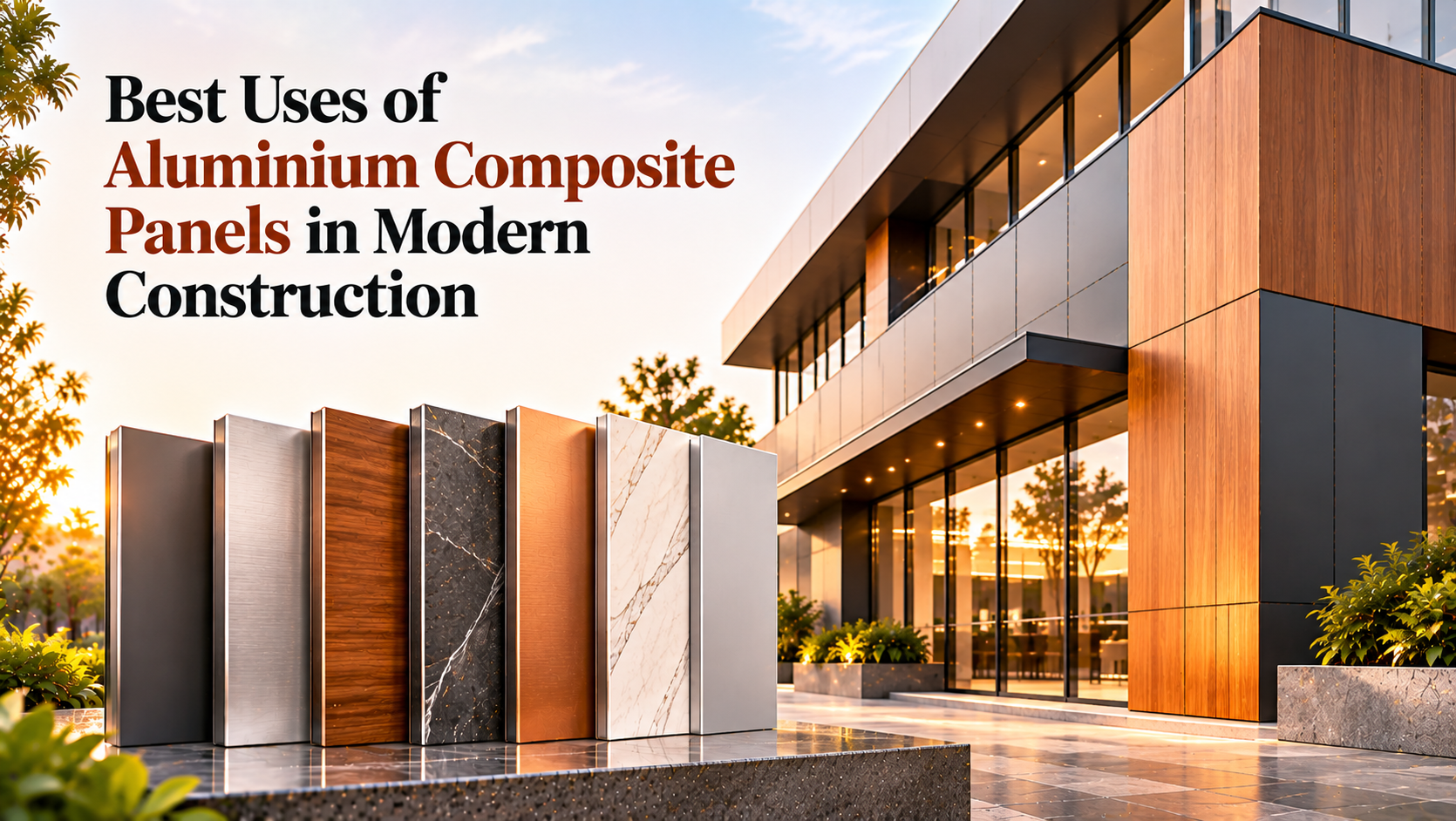
Modern construction increasingly focuses on materials that combine design flexibility, practical performance and efficient installation. Aluminium Composite Panels (ACP) have become a popular choice for architects, builders, contractors and designers because they offer a lightweight panel construction with a wide range of decorative finishes.
From commercial building façades to interior wall decoration, ACP sheets can be used in several areas of residential and commercial construction. Their availability in different colours, textures and surface finishes also makes them suitable for contemporary architectural designs.
Whether you are designing a commercial building, renovating a retail space or planning an office interior, understanding the different applications of ACP can help you make better material choices.
Here are 10 common uses of Aluminium Composite Panels in modern construction
1. Exterior Building Facades and Wall Cladding
One of the most common applications of Aluminium Composite Panels is exterior building cladding. ACP sheets are installed over suitable supporting frameworks to create clean, modern building elevations.
They are used in commercial complexes, office buildings, retail spaces, hotels and selected residential projects. Their flat surface and variety of finishes allow architects to create contemporary façades with different colours, textures and geometric patterns.
Wood-inspired, metallic, stone-inspired and solid-colour finishes can help give a building a distinctive architectural appearance.
Why use ACP for facades?
- Offers a lightweight cladding option.
- Provides different decorative surface finishes.
- Can be fabricated into various panel shapes.
- Supports contemporary architectural designs.
For exterior applications, the panel’s core, coating, fire classification, fixing system and façade design must meet the project’s technical and regulatory requirements.
2. Interior Wall Cladding and Feature Walls
ACP sheets are also used for interior wall cladding in offices, hotels, showrooms, reception areas and commercial spaces.
Decorative ACP finishes can transform plain walls into attractive feature surfaces. Wooden textures can create a warm appearance, while metallic and solid-colour finishes can complement modern interiors.
Interior ACP panels can be used behind reception desks, in lobby areas, around display sections and on selected decorative walls.
Popular applications include:
- Office reception walls
- Hotel lobby interiors
- Retail showroom walls
- Decorative feature walls
- Commercial corridors
The selected panel should meet the applicable interior fire-safety, cleaning and impact-resistance requirements.
3. Retail Shop Fronts and Store Elevations
A well-designed shop front helps businesses create a strong first impression. ACP sheets are commonly used for retail elevations because they allow businesses to incorporate brand colours, decorative finishes and structured façade designs.
They can be used around entrances, display windows, signage backgrounds and exterior wall sections.
For example, a clothing boutique may use wooden-finish ACP sheets for a warm appearance, while an electronics showroom may prefer metallic or solid-colour finishes.
Combining ACP with glass, lighting and suitable signage can create a coordinated storefront design.
4. Corporate Signage and Advertising Boards
ACP sheets are widely used as substrates for commercial signage and advertising displays. Their flat surfaces make them suitable for printed graphics, lettering and brand displays.
Businesses use ACP signboards for shop names, office branding, directional signs, promotional displays and outdoor advertising.
They can also be fabricated into different shapes and sizes according to signage requirements.
However, signage-grade ACP should not automatically be used for building façades. The required panel thickness, aluminium skin, coating and core specification can differ between signage and architectural cladding applications.
5. Canopies and Entrance Covers
Canopies are important architectural elements that enhance building entrances and provide shelter from direct sunlight and rain.
ACP sheets can be used to cover suitable canopy structures and create a coordinated appearance with the building façade. They are commonly considered for commercial entrances, retail stores, office buildings and showrooms.
Different finishes can be selected to match the exterior design. For example, metallic surfaces can complement contemporary commercial buildings, while wooden textures can create a warmer entrance design.
Canopy applications require appropriate structural support, drainage, ventilation, fixing and weather-resistant specifications.
6. False Ceilings and Soffit Cladding
ACP sheets can be used in selected ceiling and soffit applications to create clean architectural surfaces.
A soffit is the underside of a roof projection, balcony, canopy or building overhang. ACP panels can provide a finished appearance to these areas while complementing the surrounding façade.
Interior ceiling applications may include commercial lobbies, showrooms and selected decorative spaces.
For these installations, designers should consider panel support, access for maintenance, ventilation, fire requirements and the possibility of moisture or heat accumulation.
7. Column Cladding and Decorative Architectural Features
Columns are structural elements, but they can also contribute to a building’s overall visual design.
ACP sheets can be fabricated and installed around suitable columns to create decorative covers. They can also be used for selected beams, entrance frames, fascia sections and other architectural details.
Depending on the design, panels may be fabricated into rectangular, angular or curved forms using suitable fabrication techniques.
Metallic, wooden and solid-colour finishes can help coordinate columns with the rest of the building exterior.
8. Office Partitions and Interior Dividers
ACP sheets can be incorporated into selected interior partition and divider designs. They provide decorative surfaces for commercial spaces that need visual separation between different areas.
For example, ACP panels may be used in office reception dividers, display partitions, showroom sections and decorative room dividers.
However, ACP should not be treated as a complete structural or acoustic partition system by itself. The supporting framework, insulation, fire performance and acoustic requirements must be considered separately.
9. Lift Lobbies and Elevator Surrounds
Lift lobbies are among the most visible shared spaces in commercial buildings, hotels and residential complexes.
ACP sheets can be used as decorative wall cladding around lift entrances and selected lobby surfaces. Their range of finishes allows designers to coordinate the elevator surroundings with the building’s interior theme.
Metallic and textured finishes can complement contemporary commercial interiors, while wooden finishes may suit warmer design concepts.
Material selection should account for scratch resistance, cleaning frequency, fire requirements and the level of public use.
10. Exhibition Stalls, Kiosks and Display Units
ACP sheets can also be used in temporary and permanent display environments. Their fabrication flexibility makes them useful for selected kiosk panels, exhibition displays, product presentation areas and retail fixtures.
Businesses can use different colours and surface finishes to create display structures that align with their branding.
Examples include:
- Exhibition display panels
- Retail product display backgrounds
- Commercial kiosks
- Reception counters and decorative surrounds
- Promotional display structures
The panel specification should match the intended duration of use, handling requirements and installation conditions.
Benefits of Using Aluminium Composite Panels in Modern Construction
ACP sheets offer several practical and design-related advantages when selected for suitable applications.
1. Lightweight Construction
ACP uses a composite structure consisting of aluminium skins and a central core. This construction can provide a lightweight alternative to some solid metal panel options.
2. Wide Range of Finishes
ACP sheets are available in different colours, textures and decorative finishes. These options help architects create coordinated interior and exterior designs.
3. Design Flexibility
ACP panels can be cut, routed, folded and fabricated into different shapes, making them suitable for several architectural applications.
4. Consistent Surface Appearance
Their flat surfaces and available finishes can help create a uniform appearance across selected façade and interior areas.
5. Maintenance Considerations
Appropriately specified ACP surfaces can generally be cleaned using suitable methods recommended by the manufacturer. Maintenance requirements depend on the finish, environment and installation quality.
How to Choose the Right ACP Sheet for Your Construction Project
Not every ACP sheet is suitable for every application. Before selecting a panel, consider the following factors:
| Selection factor | What to check |
| Application | Confirm whether the panel is intended for interior, exterior or signage use. |
| Panel thickness | Select according to the design and manufacturer’s recommendations. |
| Aluminium skin | Check the aluminium skin thickness and material specifications. |
| Core composition | Review the core type and required fire-performance classification. |
| Surface coating | Select a coating suitable for the expected environmental exposure. |
| Finish | Choose a colour or texture that complements the building design. |
| Installation | Confirm the fixing system, supporting framework and joint details. |
| Documentation | Request technical specifications, test reports and warranty information. |
For exterior façades and public buildings, fire performance should receive particular attention. The complete façade assembly, not just the visible panel, must be assessed against the applicable building regulations and project requirements.
Frequently Asked Questions About Aluminium Composite Panels
1. What are Aluminium Composite Panels used for?
Aluminium Composite Panels are used for exterior building façades, interior wall cladding, shop fronts, signage, canopies, soffits, ceilings, column covers, partitions and decorative architectural features.
2. Are ACP sheets suitable for exterior construction?
Yes. ACP sheets specifically designed for exterior applications can be used for building façades, commercial elevations and selected outdoor architectural features. The coating, core, panel specifications and installation system must suit the project.
3. Can ACP sheets be used for interior decoration?
Yes. ACP sheets can be used for interior feature walls, reception areas, showroom walls, lift lobbies and selected ceiling applications. The product should meet the relevant interior fire and performance requirements.
4. Are ACP sheets suitable for commercial buildings?
ACP sheets are commonly used in commercial buildings for façade cladding, signage, entrance features, interior walls and decorative architectural elements. The correct product specification depends on the building type and application.
5. Can ACP sheets be used for shop signboards?
Yes. ACP sheets are commonly used as signboard substrates because of their flat surface and fabrication flexibility. However, signage-grade panels may have different specifications from façade-grade panels.
6. What is the difference between interior and exterior ACP sheets?
Exterior ACP sheets are selected for outdoor exposure and require suitable coating and weathering performance. Interior ACP sheets are intended for indoor applications, where factors such as fire requirements, cleaning and surface durability may be more relevant.
7. Are all ACP sheets fire-resistant?
No. Fire performance depends on the panel’s core composition and tested specifications. Always verify the relevant fire classification and test documentation instead of assuming that every ACP sheet has the same fire performance.
8. How do I maintain ACP sheets?
Clean ACP surfaces with a soft cloth or sponge and a suitable cleaning solution recommended by the manufacturer. Avoid abrasive tools and harsh chemicals that may damage the coating.
9. Can ACP sheets be used for curved architectural designs?
Yes. ACP sheets can be routed, folded or rolled into certain curved shapes using suitable fabrication methods. The achievable shape depends on panel specifications, fabrication technique and minimum bending radius.
10. Which ACP finish is suitable for modern building designs?
The choice depends on the architectural style. Wooden finishes create a warm appearance, metallic finishes provide a contemporary look, and solid colours offer a clean and minimal design.
Explore Aluminium Composite Panel Finishes with Pioneer Panels
Aluminium Composite Panels have become a versatile material in modern construction, with applications ranging from exterior façades and retail elevations to interior walls, signage and architectural features.
The right panel selection depends on the intended application, design requirements, fire performance, surface finish and installation specifications.
Pioneer Panels offers metal composite panel solutions across several finish collections, including:
- Wood: Natural Timber, Timber Rustic, Timber Textured and Timber Hues.
- Metal: Neo, Magma Metal and Metaltek.
- Colours: Glossy, Solid Colour and Metallic Colour.
- Earth: Natural Surfaces, Natural Stone, Sand, Rustic and Suede.
- Innovation: Opulent, Galaxy, Pure, Aurora Hues, Verve and Vogue.
These collections offer different surface design possibilities for architectural and decorative applications. Explore Pioneer Panels’ available finishes and select a solution that matches your project’s design and technical requirements.