
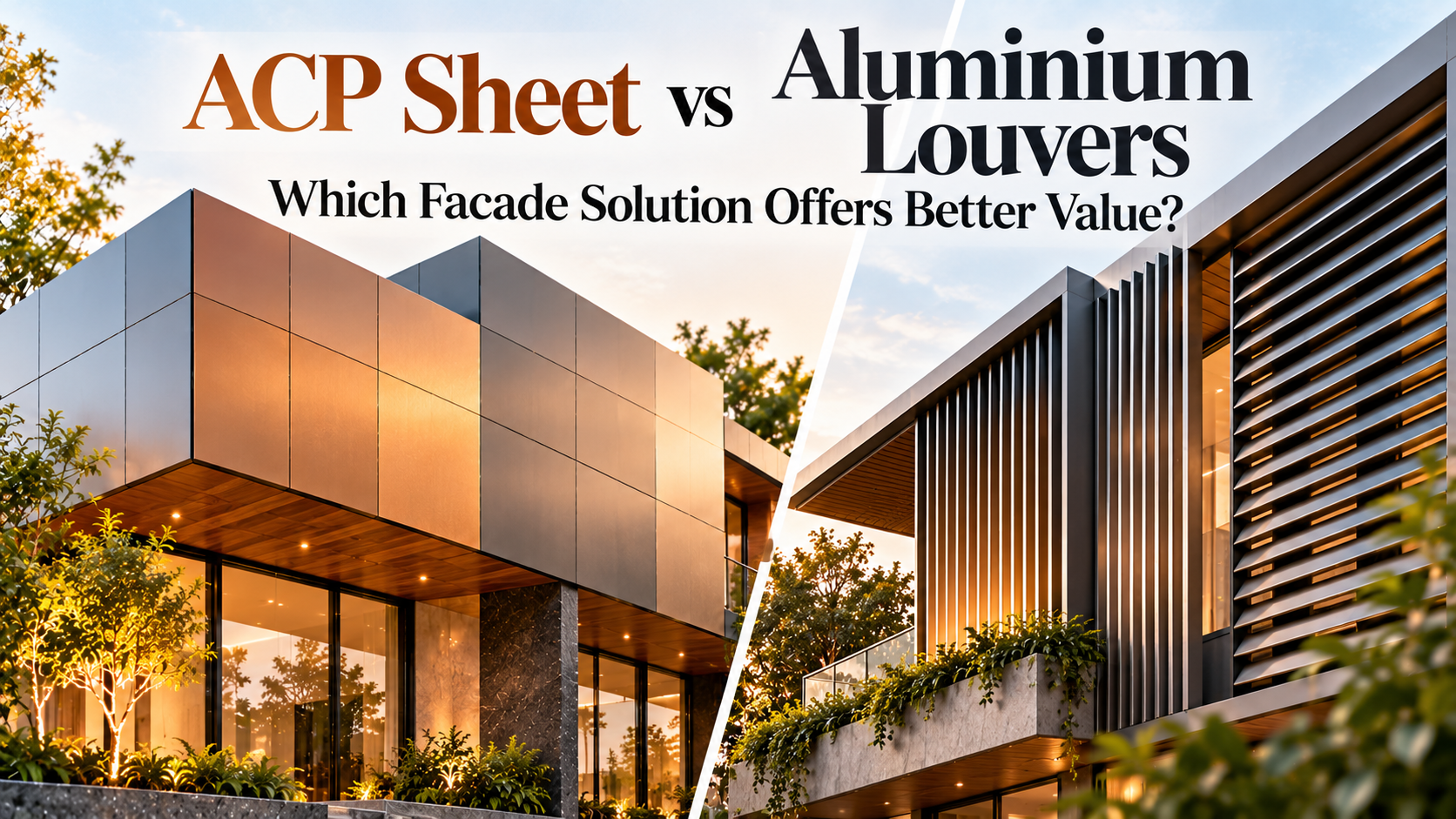
Modern building facades do much more than protect a structure from external weather conditions. They influence a building’s appearance, energy performance, maintenance requirements, and long-term value. With architects and property owners increasingly exploring contemporary facade materials, Aluminium Composite Panels (ACP sheets) and aluminium louvers have become popular options for residential, commercial, and industrial projects.
Both materials offer a modern architectural appearance, but they serve different purposes. ACP sheets are commonly used to create smooth, continuous surfaces with a wide variety of colours and finishes, while aluminium louvers introduce depth, shading, ventilation, and visual texture to a facade.
So, which option offers better value: ACP sheets or aluminium louvers? The answer depends on your building design, budget, climate, performance requirements, and long-term maintenance expectations.
In this guide, we compare ACP sheets and aluminium louvers based on cost, durability, aesthetics, weather resistance, maintenance, installation, and practical applications to help you make an informed decision.
What Are ACP Sheets?
Aluminium Composite Panels, commonly known as ACP sheets, are composite cladding panels made with two aluminium outer skins bonded to a central core. They are manufactured in various thicknesses, colours, textures, and finishes, making them suitable for different architectural applications.
ACP sheets are widely used in modern building facades because they provide a relatively lightweight cladding solution with a clean, uniform appearance.
Key Features of ACP Sheets
- Smooth and consistent surface finish
- Wide selection of colours and textures
- Wood, stone, metallic, glossy, and solid-colour options
- Lightweight construction compared with many traditional cladding materials
- Suitable for decorative facade designs
- Can be fabricated into different shapes and panel layouts
- Relatively straightforward surface cleaning
ACP sheets are particularly useful when a building requires large, continuous facade surfaces, strong colour coordination, or a contemporary architectural appearance.
However, their performance depends on the panel specification, aluminium skin thickness, core composition, coating, installation system, and environmental exposure.
What Are Aluminium Louvers?
Aluminium louvers are architectural elements made from aluminium blades or profiles arranged at specific angles or in repeated patterns. They can be installed horizontally, vertically, or in custom configurations depending on the design and intended function.
Unlike conventional flat ACP cladding, louvers create a layered facade with visible gaps between the blades. These gaps can allow airflow, filter sunlight, provide partial screening, and create changing shadow patterns throughout the day.
Key Features of Aluminium Louvers
- Contemporary architectural appearance
- Three-dimensional facade design
- Potential for solar shading
- Airflow through appropriately designed open systems
- Privacy and visual screening
- Multiple blade shapes, colours, and orientations
- Suitability for decorative and functional applications
Aluminium louvers are often used on commercial buildings, office facades, parking structures, balconies, service areas, window screens, and building exteriors where shading or ventilation is desirable.
Their actual performance depends on blade geometry, spacing, orientation, coating, mounting arrangement, and the building’s location.
ACP Sheets vs Aluminium Louvers: Key Differences
The main difference is that ACP sheets generally create a continuous cladding surface, while aluminium louvers create a layered screen or facade system.
| Feature | ACP Sheets | Aluminium Louvers |
| Basic design | Flat or fabricated composite panels | Repeated aluminium blades or profiles |
| Appearance | Smooth, continuous facade | Layered, dimensional facade |
| Colour choices | Wide range of colours and decorative finishes | Wide range of colours and profile finishes |
| Solar shading | Limited unless combined with additional design features | Can provide shading depending on blade angle and spacing |
| Airflow | Generally forms a solid surface when installed as cladding | Can permit airflow through open gaps |
| Privacy | Provides screening where installed as a solid surface | Provides partial screening depending on blade orientation |
| Installation | Requires suitable framing, joints, and fixing systems | Requires supports and accurate alignment of blades |
| Maintenance | Surface cleaning and inspection of joints and fixings | Cleaning of blades and inspection of supports and fixings |
| Best suited for | Continuous surfaces and decorative cladding | Shading, screening, ventilation, and dimensional facades |
| Cost | Depends on panel grade, finish, fabrication, and installation | Depends on profile design, spacing, quantity, supports, and installation |
Neither option is universally better. The right choice depends on what you want the facade to achieve.
1. Cost Comparison: Which Option Is More Affordable?
Cost is one of the first considerations when selecting a facade material. However, comparing only the price per square foot can be misleading because ACP sheets and aluminium louvers have different construction and installation requirements.
ACP Sheet Cost Considerations
The total cost of an ACP facade depends on:
- Overall panel thickness
- Aluminium skin thickness
- Core specification
- Surface coating and finish
- Panel size and cutting requirements
- Supporting framework
- Fabrication and installation
- Fire-performance requirements
Standard finishes may be more economical than specialised metallic, stone-inspired, or textured options. Complex facade geometry can also increase fabrication and installation costs.
Aluminium Louver Cost Considerations
Aluminium louvers may involve additional costs associated with:
- Blade profile and dimensions
- Blade spacing and orientation
- Aluminium grade and thickness
- Surface coating
- Support brackets and framework
- Custom fabrication
- Installation height and accessibility
- Shading or ventilation requirements
Closely spaced or specially shaped louvers can require more material and labour than simpler designs.
Which Offers Better Value for Money?
ACP sheets may offer better value when the primary requirement is to cover large, relatively continuous facade areas with a consistent finish.
Aluminium louvers may provide better functional value when the design also requires solar shading, privacy, screening, or airflow.
For a fair comparison, obtain quotations for the complete installed system rather than comparing the materials in isolation. Include framework, fixings, fabrication, installation, maintenance, and any necessary safety requirements.
2. Aesthetic Appeal: Flat Facades vs Modern Architectural Depth
Both materials can enhance the appearance of a building, but they create different visual effects.
ACP Sheets for Modern Facades
ACP sheets are ideal for designs that emphasise clean lines, consistent colours, and continuous surfaces.
Popular design choices include:
- Charcoal and grey facades
- White and beige combinations
- Wooden ACP accents
- Metallic silver and copper finishes
- Stone-inspired textures
- Contrasting colours around windows and entrances
For example, a modern home can combine charcoal ACP panels with a wood-finish accent around the entrance to create a premium appearance.
Aluminium Louvers for Contemporary Architecture
Louvers add dimension and rhythm to a building facade. Their blades produce light and shadow, making the building’s appearance change with the viewing angle and time of day.
Common design applications include:
- Vertical louvers around windows
- Horizontal shading above glazed areas
- Decorative screens on balconies
- Screening for parking and service areas
- Feature walls on commercial buildings
- Architectural fins on office facades
If you want a building to have depth, shading, and a more layered appearance, louvers may be the stronger design choice.
3. Durability and Weather Resistance
Durability depends on the material specification, manufacturing quality, environmental exposure, and installation quality.
ACP Sheet Durability
ACP panels with appropriate coatings can provide good resistance to normal outdoor weather exposure. However, performance varies between products.
Before selecting exterior ACP, evaluate:
- Coating type and weathering performance
- Aluminium skin thickness
- Core composition
- Resistance to corrosion in the intended environment
- Joint and edge detailing
- Fixing and support arrangements
- Warranty conditions
Poor installation, unsuitable coatings, or inadequate facade detailing can contribute to premature deterioration.
Aluminium Louver Durability
Aluminium louvers can offer good durability when the aluminium profile, coating, fixings, and supports are appropriate for the environment.
Important considerations include:
- Aluminium profile specification
- Powder coating or other surface treatment
- Corrosion protection
- Blade thickness and rigidity
- Fixing details
- Wind-load requirements
- Drainage and cleaning access
In coastal or humid environments, corrosion resistance and the compatibility of fasteners and other components are particularly important.
Verdict: Both materials can perform well outdoors when properly specified. Neither should be assumed to last longer without comparing the actual product specifications and installation systems.
4. Heat Reduction and Sunlight Control
One of the most important differences between these facade systems is their ability to influence direct sunlight.
How ACP Sheets Perform
ACP sheets create a solid cladding surface, so they do not inherently provide the same external shading effect as projecting louvers.
Their contribution to the building’s thermal performance depends on the overall facade construction, including insulation, cavity design, air gaps, and the underlying wall.
ACP cladding alone should not be treated as a substitute for a properly designed thermal envelope.
How Aluminium Louvers Perform
Louvers can intercept direct sunlight before it reaches windows or glazed surfaces. This can reduce solar heat gain under suitable conditions.
Their effectiveness depends on:
- Blade angle
- Blade depth
- Spacing between blades
- Building orientation
- Local sun path
- Window placement
- Desired daylight levels
For example, external louvers placed over sun-exposed windows may reduce direct solar radiation while still allowing some daylight and airflow.
However, poorly designed louvers may block useful daylight or offer limited shading at certain sun angles.
Verdict: Aluminium louvers generally have an advantage when external solar shading is a primary objective.
5. Ventilation and Airflow
Ventilation is another major distinction between ACP sheets and open louver systems.
ACP Sheets
When installed as a continuous cladding surface, ACP does not inherently allow airflow through the panel itself. Ventilation must be provided through a separately designed opening or facade system.
Some facade assemblies use ventilated cavities behind cladding, but this is different from airflow through the panel surface.
Aluminium Louvers
Louvers can permit airflow through the gaps between blades while providing partial visual screening.
They are useful for:
- Parking structures
- Mechanical equipment enclosures
- Service areas
- Screened balconies
- Certain ventilation openings
The airflow achieved depends on the free area between blades, blade angles, wind conditions, and any screening or mesh behind the louvers.
Verdict: Aluminium louvers are usually the more suitable option where airflow through the facade opening is required.
6. Maintenance Requirements
Both systems require periodic inspection and cleaning.
ACP Sheet Maintenance
Typical maintenance activities include:
- Cleaning accumulated dust and dirt
- Checking panel joints and sealants
- Inspecting fixings and panel alignment
- Checking for coating damage
- Addressing water-ingress issues
- Following the manufacturer’s cleaning instructions
Certain finishes may show fingerprints, water marks, or dirt more readily than others.
Aluminium Louver Maintenance
Louver maintenance generally includes:
- Cleaning dust from blade surfaces
- Inspecting brackets and fixings
- Checking for coating damage
- Removing debris where it accumulates
- Inspecting supports and alignment
- Maintaining safe access for cleaning
Closely spaced louvers or complex installations may be more difficult to clean than accessible, widely spaced profiles.
Verdict: Neither material is automatically maintenance-free. The facade design, accessibility, finish, and local environmental conditions will influence ongoing maintenance costs.
7. Installation and Fabrication
The installation process affects both the project budget and the final appearance.
ACP Sheet Installation
ACP installation usually involves measuring, cutting, fabrication, and fixing panels to an appropriate supporting framework. The selected system must accommodate movement, drainage, joints, and the relevant wind loads.
Curved surfaces and complex geometries can require additional fabrication and skilled installation.
Aluminium Louver Installation
Louver systems require accurate positioning of blades, brackets, and supports. Consistent blade spacing and alignment are essential to achieving a professional finish.
The installation method also needs to account for wind loads, blade dimensions, attachment details, and maintenance access.
Verdict: ACP may be more straightforward for simple, continuous surfaces, while louvers can involve more detailed alignment and assembly. The complexity of the particular design matters more than the material category alone.
8. Fire Safety: An Important Factor in Facade Selection
Fire performance should be considered before choosing either facade solution.
ACP panels contain a core material between their aluminium skins. The core composition can significantly influence fire behaviour, so buyers should verify the applicable fire classification and test documentation.
Aluminium louvers also require evaluation as part of the complete building design. Their aluminium profiles, coatings, attachments, and surrounding materials must meet the relevant project requirements.
For high-rise buildings, commercial projects, public facilities, and other regulated applications, consult the project fire-safety specialist and confirm compliance with applicable building codes.
Do not assume that an ACP panel is fire-safe simply because its outer skins are aluminium, or that an aluminium louver system automatically meets every facade fire requirement.
9. Which Option Is Better for Different Building Types?
| Building Type | Potentially Suitable Option | Reason |
| Modern residential facade | ACP sheets or both | Continuous surfaces and decorative finishes |
| Luxury villa | Both | Combination of wood finishes and architectural shading |
| Commercial office | Both | Corporate facade design with optional solar shading |
| Retail storefront | ACP sheets or both | Strong colour coordination and feature design |
| Parking structure | Aluminium louvers | Potential for airflow and screening |
| Sun-exposed glazed facade | Aluminium louvers or both | External shading |
| Decorative feature wall | ACP sheets or both | Choice depends on the desired texture and depth |
| Mechanical equipment enclosure | Aluminium louvers | Screening with ventilation where designed appropriately |
These are general design suggestions, not universal specifications. The building’s technical requirements should determine the final choice.
10. Can ACP Sheets and Aluminium Louvers Be Used Together?
Yes. Combining ACP sheets and aluminium louvers can create a facade that balances appearance with functionality.
For example, a commercial building could use charcoal ACP panels across the main facade, wooden-finish ACP around the entrance, and vertical aluminium louvers over selected windows.
This approach can provide:
- Continuous cladding surfaces
- Visual contrast
- Architectural depth
- External solar shading where appropriately designed
- Screening for selected areas
- More flexibility in facade composition
The key is to coordinate the two systems during the design stage so that the colours, joints, supports, drainage, fire-safety provisions, and installation details work together.
How to Choose Between ACP Sheets and Aluminium Louvers
Before finalising the facade material, ask yourself the following questions:
- Is the main goal appearance or functionality? Choose ACP for continuous cladding surfaces and consider louvers when shading, screening, or airflow is important.
- What is the available budget? Compare complete installed quotations rather than material-only prices.
- How much sunlight does the facade receive? Louvers may be useful on sun-exposed windows and glazed areas.
- What type of maintenance is practical? Consider the accessibility and cleaning requirements of the chosen design.
- What fire and building-code requirements apply? Verify the relevant documentation before procurement.
- Will the facade need a combination of finishes? Both systems can be integrated to create more distinctive designs.
- What environmental conditions will the building experience? Specify suitable coatings, fixings, and materials for the local climate.
Final Verdict: ACP Sheets vs Aluminium Louvers
ACP sheets and aluminium louvers serve different but complementary purposes in modern facade design.
ACP sheets are a strong option for continuous cladding, coordinated colours, decorative finishes, and clean architectural surfaces. They are particularly useful when a project requires a uniform facade or a combination of solid colours, wood-inspired finishes, metallic surfaces, and textures.
Aluminium louvers are a strong option for architectural depth, solar shading, ventilation, and visual screening. They are especially useful around windows, parking areas, balconies, and other locations where the space between the blades serves a functional purpose.
If your priority is a consistent exterior finish, ACP may offer better value. If you need shading, airflow, or a layered facade, aluminium louvers may be more appropriate.
For many projects, the best solution is to combine both materials and use each where it delivers the greatest benefit. Evaluate the complete installed cost, durability, maintenance, fire performance, and design requirements before making your final decision.
Frequently Asked Questions (FAQs)
1. What is the main difference between ACP sheets and aluminium louvers?
ACP sheets are composite panels used to create relatively continuous cladding surfaces. Aluminium louvers consist of spaced blades or profiles that can provide shading, ventilation, and visual screening.
2. Which is cheaper, ACP sheets or aluminium louvers?
The cost depends on the product specification, finish, design complexity, supporting framework, fabrication, and installation. ACP may be economical for simple continuous surfaces, while louvers may offer better value when their shading or ventilation functions are needed.
3. Are aluminium louvers better than ACP sheets for exterior facades?
Not in every situation. Louvers are useful for shading and airflow, whereas ACP is suitable for smooth, continuous cladding. The better option depends on the building’s functional and architectural requirements.
4. Which material is more durable: ACP sheets or aluminium louvers?
Both can provide good durability when manufactured, coated, installed, and maintained appropriately. Compare the actual material specifications, coating systems, corrosion resistance, fixings, and warranty rather than relying on the material name alone.
5. Do aluminium louvers reduce heat inside a building?
They can help reduce solar heat gain when correctly designed and positioned, particularly over sun-exposed windows and glazed surfaces. Their effectiveness depends on blade angle, spacing, orientation, and local sunlight conditions.
6. Do ACP sheets provide ventilation?
A continuous ACP cladding surface does not inherently allow airflow through the panel. Ventilation must be provided through a separately designed opening or system. A ventilated cavity behind cladding is not the same as airflow through the panel.
7. Can ACP sheets and aluminium louvers be combined in one building?
Yes. ACP sheets can cover larger facade areas while louvers can be used for window shading, balconies, screening, and decorative accents. The systems should be coordinated for structural support, drainage, fire safety, and appearance.
8. Which option requires less maintenance?
Maintenance depends on the design, finish, accessibility, and environmental conditions. ACP requires panel and joint inspections, while louvers require cleaning between blades and inspections of their supports and fixings.
9. Are aluminium louvers suitable for residential buildings?
Yes. They can be used on residential facades, balconies, windows, entrances, and privacy screens. Blade orientation and spacing should be selected according to the desired shading, ventilation, privacy, and architectural style.
10. What should I check before purchasing ACP sheets or aluminium louvers?
Check material specifications, coating quality, dimensions, wind-load requirements, installation details, warranty, maintenance needs, and applicable fire-safety requirements. Compare complete installed costs and select a system suitable for the building’s location and design.