
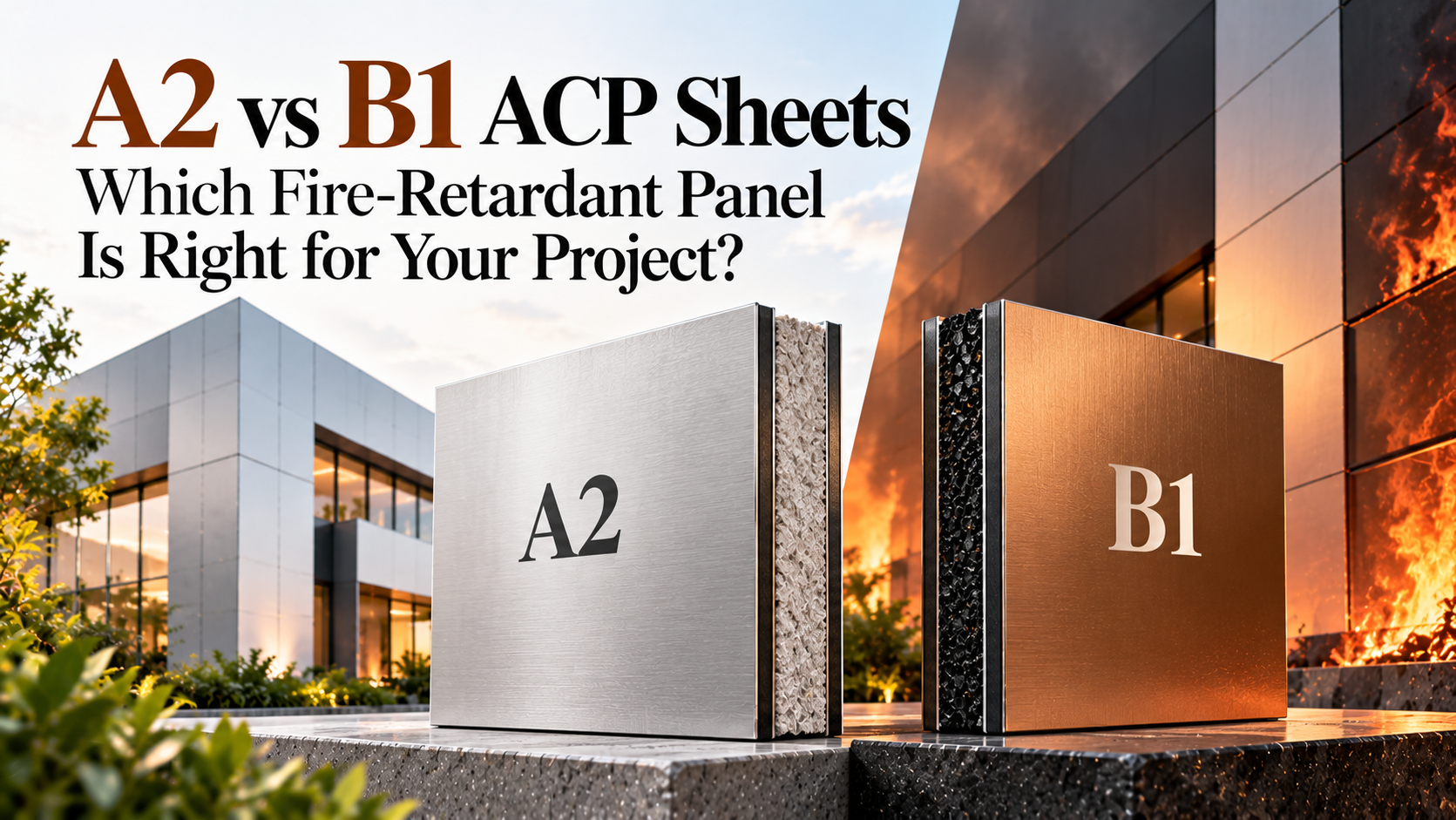
Choosing the right Aluminium Composite Panel (ACP) is an important decision for architects, builders, contractors, and property owners. While ACP sheets are widely used in modern building facades, commercial exteriors, interiors, and signage, fire performance is one of the most important factors to consider when selecting panels for a construction project. This is especially relevant for high-rise buildings, commercial complexes, hospitals, hotels, offices, and public spaces where fire safety requirements can be particularly strict.
Two fire-performance classifications frequently discussed in the ACP industry are A2 and B1. Both are associated with fire-related performance standards, but they do not represent the same classification system or necessarily offer the same level of reaction-to-fire performance. Understanding the differences can help you select a suitable panel based on your building’s requirements, local regulations, and project specifications.
In this guide, we explain A2 vs B1 ACP sheets, their key differences, applications, advantages, limitations, and the factors you should evaluate before purchasing fire-retardant ACP panels.
What Are A2 and B1 ACP Sheets?
ACP sheets consist of two aluminium outer skins bonded to a core material. The composition of the core, the panel’s complete construction, and the results of applicable fire tests influence how the panel performs when exposed to fire.
A2 and B1 are fire-related classifications commonly used in different standards and markets. However, they should not automatically be treated as equivalent grades within one universal classification system.
A2 ACP panels generally refer to panels classified as A2 under the European reaction-to-fire classification system, commonly EN 13501-1. A2 products have limited contribution to fire under the conditions of the relevant classification and test methods. Depending on the product, additional classifications may describe smoke production and flaming droplets or particles.
B1 ACP panels commonly refer to a flame-retardant classification used under certain national standards, particularly the Chinese GB 8624 classification system. The precise performance requirements depend on the applicable standard and the product’s certified classification.
The important point is that the letters and numbers alone do not provide enough information to compare two panels. Always check the exact standard, test report, and classification stated by the manufacturer.
What Is an A2 ACP Sheet?
An A2 ACP sheet is a panel that has achieved an A2 reaction-to-fire classification under the relevant European classification framework.
These panels are generally designed for projects requiring a low contribution to fire. Their core construction is typically formulated to limit combustible content, although the exact composition varies by manufacturer and product.
Key Characteristics of A2 ACP Sheets
- Limited contribution to fire under the applicable classification tests.
- Suitable for consideration in projects with demanding facade fire-performance requirements, where permitted by local regulations.
- Available in different architectural colours and finishes, depending on the manufacturer.
- May be used in commercial, institutional, and residential facade systems when the complete system meets project requirements.
- Requires supporting classification documents and technical verification.
Where Are A2 ACP Sheets Used?
A2-classified ACP panels may be considered for:
- High-rise building facades
- Commercial office buildings
- Hospitals and healthcare facilities
- Educational institutions
- Hotels and hospitality buildings
- Public buildings
- Large residential developments
The suitability of an A2 panel depends on the applicable building regulations, facade design, installation method, and any project-specific fire-safety requirements. An A2 classification alone does not establish that a complete facade system is compliant.
What Is a B1 ACP Sheet?
B1 ACP sheets are commonly described as flame-retardant panels under certain national classification systems. In the Chinese GB 8624 system, B1 is associated with flame-retardant performance.
These panels are manufactured to meet the requirements of the relevant classification, with core materials and construction intended to improve fire behaviour compared with less fire-resistant alternatives under the applicable tests.
Key Characteristics of B1 ACP Sheets
- Designed to meet the specified flame-retardant classification.
- Available in a range of colours, surface finishes, and dimensions.
- Can be used in selected architectural applications when the product meets the project’s requirements.
- May offer a different cost and performance balance from A2-classified products.
- Requires verification against the exact standard and certification.
Where Are B1 ACP Sheets Used?
Depending on local regulations and the certified product, B1 panels may be considered for certain:
- Commercial buildings
- Retail spaces
- Office interiors and exteriors
- Low-rise building applications
- Decorative cladding projects
- Signage and other approved applications
These examples are not blanket approvals. A B1 panel may be unsuitable for a particular facade if local codes or the project specification require a different classification.
A2 vs B1 ACP Sheets: Key Differences
The most important distinction is that A2 and B1 commonly refer to classifications from different standards. They should not be compared as though they were simply two grades in one interchangeable scale.
| Feature | A2 ACP Sheet | B1 ACP Sheet |
| Common classification framework | European EN 13501-1 | Commonly Chinese GB 8624 |
| General meaning | Limited contribution to fire | Flame-retardant classification under the relevant standard |
| Core construction | Depends on the certified product; often formulated for low fire contribution | Depends on the certified product and its test requirements |
| Fire-performance comparison | Requires verified classification and test details | Requires verified classification and test details |
| Potential applications | Projects requiring an A2 classification, where approved | Applications permitted by the relevant codes and project specification |
| Cost | Depends on manufacturer, construction, finish, and supply | Depends on manufacturer, construction, finish, and supply |
| Documentation | Relevant classification report and product data | Relevant classification report and product data |
Important: Do not assume that A2 is directly interchangeable with B1 or that a B1 certificate proves compliance with an A2 requirement. Ask for documentation showing the exact classification and standard.
Which ACP Sheet Offers Better Fire Performance?
The answer depends on the standards being used and the evidence available for each specific product.
An A2 classification under EN 13501-1 indicates limited contribution to fire under that classification system. A B1 classification under GB 8624 indicates performance according to a different framework.
Because the test methods and classification criteria differ, a direct comparison requires more than looking at the label. A qualified facade or fire-safety professional should evaluate the actual classification reports against the project’s required standard.
When choosing ACP for a building, consider the following:
- The fire classification explicitly required by the local building code.
- The exact test standard referenced in the product documentation.
- Whether the report applies to the precise panel construction being supplied.
- The intended facade assembly and installation method.
- Any additional smoke, flaming-droplet, or system-level requirements.
Which ACP Sheet Is Right for Your Project?
The right panel depends on the building type, height, occupancy, local regulations, and intended application.
1. High-Rise Buildings
High-rise projects often face stricter facade fire-safety requirements. Confirm the required reaction-to-fire classification and any applicable facade-system testing before specifying the panel.
An A2-classified panel may be a suitable candidate where the relevant requirements call for it, but approval depends on the entire project specification.
2. Commercial Buildings
Shopping centres, office towers, hotels, and other commercial buildings should select ACP based on their approved fire strategy, occupancy requirements, and local building regulations.
Do not choose a panel solely because it is marketed as fire-retardant.
3. Residential Buildings
For residential projects, the building’s height, construction type, and local regulations influence the acceptable panel specification. A low-rise building and a high-rise residential tower may have very different requirements.
4. Interior Applications
Interior decorative panels also need to be selected according to their intended use. Requirements can differ depending on whether the panel is installed on a wall, ceiling, escape route, or another regulated area.
5. Signage and Decorative Installations
Some signage applications have different requirements from building facade cladding. Confirm whether the product is intended for the installation location and whether any fire-safety rules apply.
Factors to Check Before Buying Fire-Retardant ACP Sheets
1. Verify the Fire-Test Report
Ask the supplier for the relevant fire-test or classification report. Check the standard, classification, report number, testing laboratory, and product description.
Make sure the report applies to the exact panel construction being purchased.
2. Check the Core Material
ACP cores vary in composition. Some are more combustible than others, and fire-retardant formulations differ by manufacturer.
Do not rely on descriptions such as “mineral core” or “FR core” alone. Verify the product’s documented performance.
3. Confirm the Overall Panel Specification
Ask for the complete technical specification, including overall thickness, aluminium skin thickness, core construction, coating, and intended application.
The thickness of the panel by itself does not establish its fire classification.
4. Evaluate the Complete Facade System
Fire performance depends on more than the ACP panel. The sub-frame, insulation, cavity barriers, fixings, joints, and other components can affect how fire spreads through a facade.
Where required, confirm that the proposed facade assembly has the appropriate system-level assessment or testing.
5. Review Installation Requirements
Even a suitably classified panel can be installed incorrectly. Use qualified installers and follow the manufacturer’s technical requirements and the project’s approved facade design.
6. Compare Warranty and Supplier Support
Check the warranty, product traceability, technical assistance, and availability of documentation. A reliable supplier should be able to explain the product specification clearly.
Common Mistakes to Avoid When Selecting A2 or B1 ACP
Comparing Labels Without Comparing Standards
A2 and B1 are not automatically equivalent classifications. Verify the standard behind each label.
Assuming Every FR Panel Has the Same Performance
“FR” is a broad description. The actual classification and test results are what matter.
Choosing Only by Price
The lowest-cost panel may not meet the required performance specification. Compare compliant products on a like-for-like basis.
Ignoring the Facade Assembly
The panel is only one part of a building’s exterior system. The supporting structure, insulation, cavity design, and fire-stopping details also matter.
Accepting Certificates Without Verification
Check that the documentation is authentic, relevant, and applicable to the product being supplied. Where necessary, request confirmation from the manufacturer or testing body.
Why Fire-Safety Compliance Matters in Modern Facade Design
Modern buildings increasingly use lightweight cladding materials to achieve clean lines, varied colours, and distinctive architectural finishes. However, a visually attractive facade must also meet the technical requirements of the building.
Correctly specified fire-retardant ACP can contribute to a compliant facade design when used as part of an appropriately designed and installed system. It is important to understand that no ACP classification alone guarantees that a building or facade is fire-safe.
Architects, consultants, developers, and contractors should coordinate material selection with fire-safety specialists early in the design process. This helps prevent costly specification changes, delays, and non-compliance during construction.
Final Verdict: A2 or B1 ACP Sheets?
There is no universal answer based on the classification label alone. Choose the panel that demonstrably meets the fire classification and facade-system requirements for your specific project.
An A2-classified ACP panel may be appropriate when a project calls for the relevant European classification. A B1 panel may be acceptable for applications governed by the applicable B1 standard, provided it meets all local and project requirements.
Before placing an order, verify the standard, classification report, panel construction, installation system, and local building-code requirements. For complex or high-rise projects, seek approval from a qualified facade consultant or fire-safety professional.
FAQs About A2 vs B1 ACP Sheets
1. What is the difference between A2 and B1 ACP sheets?
A2 is a reaction-to-fire classification commonly used under EN 13501-1, while B1 commonly refers to a flame-retardant classification under the Chinese GB 8624 system. Their criteria differ, so the labels should not be treated as directly equivalent.
2. Is A2 ACP better than B1 ACP?
You cannot reliably decide from the labels alone. A2 indicates limited contribution to fire under its classification system, while B1 is assessed under a different standard. Compare the applicable test reports and project requirements.
3. Which ACP sheet is suitable for high-rise buildings?
The correct panel depends on the local building code, required fire classification, facade assembly, and building design. Select a panel with verified documentation and obtain approval from the project’s qualified fire-safety and facade professionals.
4. Are B1 ACP sheets fireproof?
No. A flame-retardant classification does not mean a material is fireproof or non-combustible in every circumstance. B1 describes performance under the relevant classification system and test conditions.
5. Are A2 ACP sheets completely non-combustible?
An A2 classification means limited contribution to fire under the applicable classification system; it does not automatically mean the entire panel or facade system is completely non-combustible. Check the full classification and supporting reports.
6. How can I verify whether an ACP sheet is genuinely A2 or B1 classified?
Request the official classification or fire-test report. Verify the standard, product description, manufacturer, testing laboratory, report number, and scope. Confirm that the documentation matches the actual product being supplied.
7. Does ACP sheet thickness affect fire resistance?
Thickness alone does not establish fire performance. Core composition, complete panel construction, and verified test results are essential. Always review the classification report for the specified panel.
8. Can fire-retardant ACP sheets be used for interior applications?
They may be suitable for certain interior applications, but requirements vary by building type, location, and local regulations. Confirm the required classification and whether the product is approved for its intended use.
9. What other factors should I check besides fire classification?
Review the aluminium skin thickness, overall panel thickness, coating, weather resistance, durability, warranty, fabrication compatibility, installation method, and complete facade-system requirements.
10. What documents should I request before purchasing A2 or B1 ACP sheets?
Request the product technical data sheet, relevant fire-test or classification report, applicable certificates, installation guidance, and warranty documentation. For regulated projects, also obtain the approvals or system-level evidence required by the local building code.