
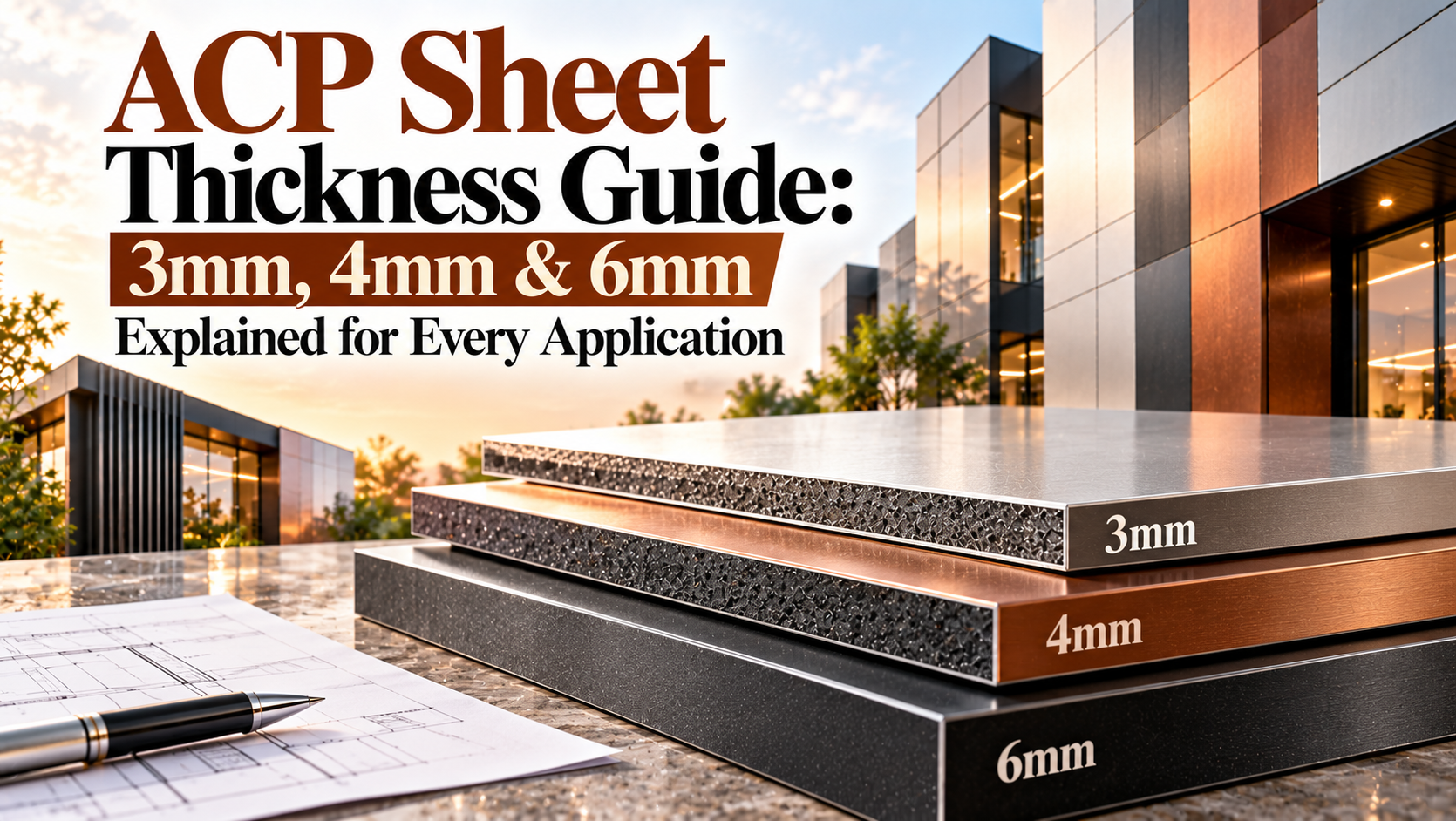
Choosing the right Aluminium Composite Panel (ACP) sheet thickness is an important step in any construction, renovation, or architectural project. ACP sheets are widely used for building facades, commercial exteriors, shopfronts, signage, interior walls, and decorative applications because of their lightweight construction, attractive finishes, and design flexibility. However, selecting the wrong thickness can affect panel rigidity, installation requirements, overall cost, and long-term performance.
Among the most commonly discussed ACP sheet thicknesses are 3mm, 4mm, and 6mm. Each option serves different purposes depending on the panel’s construction, the size of the installation, the supporting framework, wind loads, and the intended application. While 3mm panels are often considered for signage and selected interior uses, 4mm panels are commonly specified for architectural cladding, and 6mm panels may be considered for applications requiring a thicker panel construction or particular design requirements.
It is important to understand that overall ACP thickness alone does not determine strength or suitability. Aluminium skin thickness, core composition, panel dimensions, fixing methods, and the manufacturer’s specifications also play a significant role.
In this guide, we explain the differences between 3mm, 4mm, and 6mm ACP sheets, their applications, advantages, limitations, and the factors you should consider before purchasing.
What Is ACP Sheet Thickness?
Aluminium Composite Panel thickness refers to the total thickness of the panel, including its two aluminium outer skins and the core material between them.
An ACP sheet typically consists of:
- Front aluminium skin: Provides the external surface and contributes to the panel’s rigidity.
- Core material: Bonds the two aluminium skins and contributes to the panel’s overall construction and performance.
- Back aluminium skin: Supports the composite structure and provides the rear surface.
- Protective coating: Helps maintain the appearance and protect the exposed surface, depending on the coating specification.
For example, a 4mm ACP sheet has an overall nominal thickness of 4mm. However, two 4mm ACP products from different manufacturers may perform differently because their aluminium skin thicknesses, core materials, coatings, and manufacturing quality can vary.
Therefore, when selecting ACP sheets, evaluate the complete product specification instead of choosing solely by the overall thickness.
3mm vs 4mm vs 6mm ACP Sheets: Key Differences
The following table provides a general comparison of the three thickness options.
| Feature | 3mm ACP Sheet | 4mm ACP Sheet | 6mm ACP Sheet |
| Overall thickness | 3mm | 4mm | 6mm |
| Typical applications | Signage, selected interiors, decorative panels | Architectural cladding, shopfronts, selected exterior facades | Selected specialised cladding or design applications requiring a thicker panel |
| Weight | Generally lower for comparable construction | Depends on core and aluminium skin specification | Often higher for comparable construction |
| Rigidity | Depends on skin thickness, core, and panel dimensions | Depends on complete panel construction | Greater thickness does not automatically guarantee superior performance |
| Installation | Depends on application and fixing method | Requires suitable facade support and installation | May require application-specific fabrication and support |
| Cost | Often economical for suitable applications | Varies with specification and finish | May cost more, depending on product construction |
| Exterior suitability | Only when the product is approved for the intended use | Commonly considered for exterior cladding when appropriately specified | Depends on the particular product and system design |
Important: These are general guidelines, not universal rules. A 3mm panel is not automatically unsuitable for every exterior application, and a 6mm panel is not automatically stronger or safer than a properly specified 4mm panel. Always verify the manufacturer’s technical documentation and project requirements.
1. 3mm ACP Sheets: Features, Benefits and Applications
3mm ACP sheets are often used in applications where lightweight construction, easy fabrication, and cost control are important.
They can be suitable for certain signage installations, decorative features, interior wall cladding, and other applications permitted by the product specification.
Key Benefits of 3mm ACP Sheets
- Lightweight construction for suitable applications.
- Easy cutting and fabrication when handled correctly.
- Available in a variety of colours and finishes.
- Useful for decorative installations and signage.
- May offer an economical solution when the application does not require a thicker panel.
Common Applications of 3mm ACP Sheets
Signboards and advertising displays: Three-millimetre panels are commonly considered for selected business signs, retail displays, and advertising boards, depending on their dimensions and support arrangements.
Interior decoration: They may be suitable for certain wall features, decorative partitions, and interior installations where the manufacturer permits their use.
Small decorative panels: Compact panels and feature elements may use 3mm ACP when the design, fixing method, and expected loads are appropriate.
Limitations of 3mm ACP Sheets
A thinner panel may be less suitable for large unsupported spans or applications exposed to significant wind loads if the product and supporting system are not designed for those conditions.
Before choosing 3mm ACP for exterior use, verify its approved application, aluminium skin thickness, core composition, fixing requirements, and relevant performance documentation.
2. 4mm ACP Sheets: A Common Choice for Architectural Cladding
Four-millimetre ACP sheets are widely considered for architectural cladding because they offer a versatile option for many facade designs. They are available in numerous finishes, including solid colours, metallic shades, wood-inspired patterns, and stone-inspired textures.
However, suitability for a specific building depends on the actual panel specification and the complete installation system.
Key Benefits of 4mm ACP Sheets
- Available in a broad range of architectural finishes.
- Suitable for many facade designs when correctly specified.
- Can be fabricated into different panel shapes and layouts.
- Offers flexibility for modern commercial and residential exteriors.
- Can be incorporated into designs featuring glass, metal, and other cladding materials.
Common Applications of 4mm ACP Sheets
Commercial building facades: Four-millimetre panels are frequently considered for office buildings, retail complexes, showrooms, and commercial properties.
Residential exteriors: They can be used for selected exterior features, entrance areas, balcony accents, and decorative facade sections when the product meets the applicable requirements.
Shopfronts and retail exteriors: Their range of finishes allows businesses to coordinate facade colours with signage and brand identity.
Architectural features: Designers may use 4mm ACP for geometric patterns, contrasting panels, and decorative exterior elements.
Why Is 4mm ACP Often Preferred for Facades?
The popularity of 4mm ACP reflects its availability and versatility across many architectural applications. However, its suitability should never be assumed from thickness alone.
For building exteriors, confirm the aluminium skin thickness, core type, wind-load requirements, fixing system, coating durability, and fire-performance classification. High-rise and other regulated projects may have specific requirements that determine which products can be used.
3. 6mm ACP Sheets: When Should You Consider Them?
Six-millimetre ACP sheets are thicker than standard 3mm and 4mm options, but they are not automatically the best choice for every project.
Their suitability depends on the specific product, panel dimensions, installation arrangement, and the technical performance required by the application.
Potential Benefits of 6mm ACP Sheets
- May suit specialised designs requiring a thicker overall panel.
- Can be considered where the specified product offers the necessary rigidity and fabrication characteristics.
- Available in selected architectural applications, depending on the manufacturer.
- May meet particular project requirements when supported by appropriate technical documentation.
Potential Applications of 6mm ACP Sheets
A 6mm panel may be considered for selected architectural or decorative installations where the manufacturer has approved the product for the intended use.
However, do not assume that all 6mm ACP sheets are suitable for large exterior facades, structural applications, or high-wind environments. Some manufacturers may offer thicker composite panels for particular uses, while others may not recommend them for standard facade systems.
What Should You Check Before Choosing 6mm ACP?
Before purchasing, evaluate:
- The product’s intended application.
- Aluminium skin thickness and core composition.
- Panel dimensions and allowable unsupported spans.
- Wind-load and fixing requirements.
- Compatibility with the supporting framework.
- Fabrication limitations and installation guidance.
- Fire-performance and regulatory requirements.
For many projects, a correctly specified 4mm panel may be more suitable than a thicker product that has not been designed for the intended facade system.
4. Which ACP Sheet Thickness Is Best for Exterior Cladding?
The ideal thickness for exterior cladding depends on the building design, exposure conditions, and the manufacturer’s approved system.
For many architectural facade projects, 4mm ACP is a commonly considered option. Nevertheless, the complete specification must be evaluated before it can be recommended for a particular building.
When selecting ACP for exterior use, consider the following factors.
Building Height and Wind Load
Wind pressure and suction can influence the loads acting on facade panels, especially on taller buildings and exposed corners. The panel size, support spacing, aluminium skin thickness, and fixing arrangement all influence performance.
Aluminium Skin Thickness
Two panels with the same overall thickness may have different aluminium skin thicknesses. This can affect stiffness, fabrication, and other performance characteristics.
Core Material and Fire Performance
The core material affects important properties, including fire behaviour. For regulated commercial and residential projects, verify the applicable fire classification and supporting reports.
Coating and Weather Resistance
Exterior panels should have coatings suitable for the expected exposure to sunlight, moisture, pollution, and other environmental conditions.
Supporting Framework and Fixing System
A properly designed framework and installation system are essential. The panel must be installed according to the approved details and manufacturer instructions.
Recommendation: Select the thickness and panel specification through the project design requirements rather than relying on a generic rule that one thickness suits every exterior facade.
5. Which ACP Sheet Thickness Is Best for Signage?
For signboards, ACP thickness should be selected according to the board dimensions, mounting arrangement, wind exposure, and whether the sign is installed indoors or outdoors.
When to Consider 3mm ACP
Three-millimetre ACP may be appropriate for smaller signs and selected display applications when the manufacturer permits the intended use and the mounting system provides adequate support.
When to Consider 4mm ACP
Four-millimetre panels may be appropriate for certain larger or more demanding signage applications, depending on the product specification and support design.
Should You Choose 6mm ACP for Signboards?
A thicker panel is not automatically necessary for signage. The correct choice depends on the board dimensions, structural support, mounting details, and the manufacturer’s guidance.
For large outdoor signboards, ensure that the complete sign structure is designed to withstand wind loads. Do not rely on ACP thickness alone to provide structural stability.
6. How Does ACP Thickness Affect Cost?
ACP sheet pricing depends on more than overall thickness. The aluminium skin thickness, core material, surface finish, fire classification, brand, panel dimensions, and order quantity can all affect the final price.
In general, thicker or more specialised products may cost more, but this is not a universal rule across manufacturers and specifications.
Other costs to consider include:
- Supporting framework.
- Cutting and fabrication.
- Installation labour.
- Fixings and accessories.
- Transportation and handling.
- Maintenance and replacement.
- Required testing or compliance documentation.
To compare quotations accurately, ask suppliers to specify the overall thickness, aluminium skin thickness, core composition, finish, applicable standards, and warranty.
A cheaper panel may not deliver better value if it fails to meet the project’s technical requirements. Similarly, selecting a thicker product without a practical need may increase costs without delivering a meaningful benefit.
7. Common Mistakes to Avoid When Selecting ACP Sheet Thickness
Choosing Only by Overall Thickness
Overall thickness does not provide a complete picture of panel performance. Check the aluminium skins, core material, product specification, and intended application.
Assuming Thicker Always Means Better
A 6mm panel is not automatically the safest or strongest option. Performance depends on the complete panel construction and installation system.
Ignoring Fire-Safety Requirements
Not all ACP products have the same fire performance. Confirm the applicable requirements and supporting documentation before using panels on a regulated building.
Overlooking Installation Quality
Incorrect fixing, unsuitable support spacing, or poor joint detailing can compromise a facade regardless of the panel’s nominal thickness.
Comparing Prices Without Comparing Specifications
Ensure that quotations refer to equivalent products, including aluminium skin thickness, core composition, finish, and approved application.
Ignoring Environmental Conditions
Sunlight, rain, coastal exposure, and wind conditions may influence product selection. Choose a panel and coating appropriate for the building’s environment.
8. Checklist Before Buying 3mm, 4mm or 6mm ACP Sheets
Use this checklist before finalising your purchase:
- Confirm the intended application: signage, interior decoration, or exterior cladding.
- Check the total panel thickness.
- Verify the thickness of both aluminium skins.
- Review the core composition and fire-performance classification.
- Confirm coating suitability for indoor or outdoor use.
- Check panel dimensions, support spacing, and fixing requirements.
- Verify the manufacturer’s approved applications.
- Review warranty conditions and installation instructions.
- Compare complete quotations from suppliers.
- Consult a qualified facade professional for complex or regulated projects.
This process can help you select an ACP panel that meets your project’s performance requirements while avoiding unnecessary costs.
Conclusion
Selecting the correct ACP sheet thickness is essential for achieving the right balance between appearance, durability, installation requirements, and cost.
Three-millimetre ACP sheets are commonly considered for signage and selected decorative applications. Four-millimetre ACP sheets are frequently used in architectural cladding when the complete product and installation system meet project requirements. Six-millimetre panels may be appropriate for particular specialised applications, but their suitability must be verified with the manufacturer.
The most important principle is that ACP sheet thickness should never be the only factor guiding your decision. Aluminium skin thickness, core composition, panel dimensions, wind loads, surface coating, fire performance, and installation details all contribute to the final result.
Before purchasing, compare the full technical specifications and choose a product designed for your intended application. For exterior facades and other safety-sensitive projects, consult a qualified professional to ensure the complete system meets the relevant building requirements.
Frequently Asked Questions (FAQs)
1. What is the difference between 3mm, 4mm and 6mm ACP sheets?
The main difference is the overall thickness of the panel. However, actual performance also depends on aluminium skin thickness, core composition, panel dimensions, and installation details. The appropriate option depends on the intended application and technical requirements.
2. Which ACP sheet thickness is best for building exteriors?
Four-millimetre ACP is commonly considered for architectural cladding, but it is not automatically suitable for every exterior. Building height, wind loads, fire regulations, panel construction, and the approved installation system determine the correct specification.
3. Is 3mm ACP suitable for exterior use?
It can be suitable for certain exterior applications when the specific product is approved for that purpose and the design meets relevant requirements. Check the manufacturer’s documentation before using 3mm ACP on a building facade.
4. Is 4mm ACP better than 3mm ACP?
Not necessarily for every application. A 4mm panel has a greater overall thickness, but suitability and performance depend on its construction, dimensions, support arrangement, and intended use. A 3mm panel may be adequate for certain signage or decorative applications.
5. Is 6mm ACP stronger than 4mm ACP?
Not automatically. A thicker panel may offer different stiffness characteristics, but strength and performance depend on aluminium skin thickness, core construction, panel dimensions, and fixing methods. Compare technical specifications rather than thickness alone.
6. Which ACP sheet thickness is best for signboards?
Three-millimetre ACP is commonly considered for smaller signs, while 4mm may be appropriate for some larger applications. The correct choice depends on sign dimensions, wind exposure, mounting details, and manufacturer recommendations.
7. Does ACP sheet thickness affect its price?
Yes, thickness can influence pricing, but it is only one factor. Aluminium skin thickness, core material, coating, fire classification, brand, and fabrication requirements also affect the total cost.
8. What is the difference between ACP sheet thickness and aluminium skin thickness?
Overall ACP thickness includes both aluminium skins and the central core. Aluminium skin thickness refers to the thickness of an individual aluminium layer. Two panels with the same overall thickness can have different skin thicknesses and performance characteristics.
9. Is ACP sheet thickness related to fire resistance?
Overall thickness alone does not establish fire resistance. Core composition and the complete panel construction are important. Always check the product’s applicable fire classification and supporting test documentation.
10. How do I choose the right ACP sheet thickness for my project?
Start by identifying the application, panel dimensions, environmental exposure, and applicable building requirements. Then compare the aluminium skin thickness, core material, coating, fixing system, and manufacturer specifications. For exterior cladding, consult a qualified facade professional when necessary.
11. Can 3mm ACP sheets be used for interior decoration?
Yes, 3mm ACP may be suitable for certain interior wall features, decorative panels, and partitions when the product is approved for the intended use. Confirm the required fire performance and installation details.
12. What should I check before buying ACP sheets?
Check the overall thickness, aluminium skin thickness, core composition, surface finish, fire classification, weather resistance, installation requirements, warranty, and intended application. Comparing these details helps ensure that the selected panel offers suitable performance and value.