
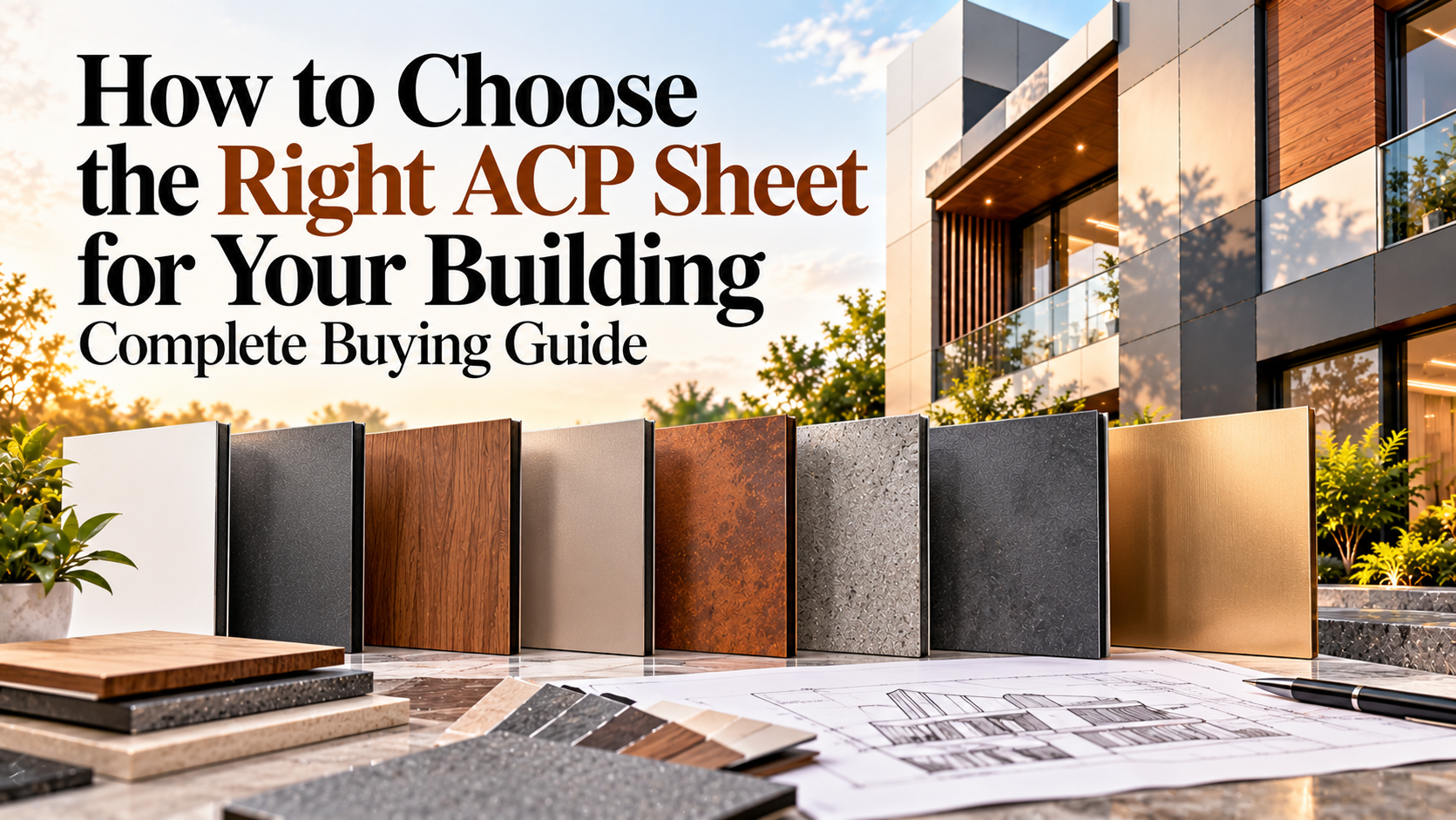
Choosing the right ACP sheet for a building is not simply about selecting an attractive colour or the lowest price. The right Aluminium Composite Panel needs to match the building’s application, location, design, required durability, fire-safety needs, coating, thickness, and installation system.
With so many ACP sheet types, colours, textures, finishes, thicknesses, and core options available, it can be difficult to know which panel is actually suitable for a particular project.
A panel that works well for an indoor feature wall may not be the right choice for an exterior facade. Similarly, a decorative ACP selected for a low-rise residential project may not meet the requirements of a larger commercial or high-rise building.
This 2026 ACP buying guide explains the most important factors to consider before purchasing ACP sheets so you can make a more informed decision.
What Is an ACP Sheet?
ACP stands for Aluminium Composite Panel. It is a composite cladding material made by combining aluminium layers with a core material.
The panels are available in different thicknesses, colours, finishes, textures, and specifications for applications ranging from interiors and signage to exterior building facades.
ACP sheets are popular in modern architecture because they can provide a clean and contemporary appearance while being comparatively lightweight and easy to fabricate.
Why Is Choosing the Right ACP Sheet Important?
Not every ACP sheet is designed for the same application.
Choosing the wrong specification can result in problems such as:
- Poor surface flatness
- Colour fading
- Surface damage
- Improper fire performance
- Difficult fabrication
- Premature maintenance
- Unsatisfactory appearance
- Higher replacement or maintenance costs
The most important point is to evaluate the complete ACP specification, rather than choosing a panel based only on colour and price.
1. Start With the Application
The first question should always be:
Where will the ACP sheet be used?
The requirements for an exterior facade are different from those of an interior wall or a sign board.
Exterior Building Facades
Exterior ACP needs to handle exposure to sunlight, rain, humidity, dust, temperature changes, and other environmental conditions.
For facade applications, pay close attention to:
- Panel thickness
- Aluminium skin thickness
- Core type
- Coating system
- Weather resistance
- Fire performance
- Installation system
Interior Applications
Interior walls, ceilings, partitions, furniture surfaces, and decorative elements may have different technical requirements.
For example, an ACP sheet used for an indoor feature wall does not necessarily need the same specification as an exterior facade panel.
Signage Applications
ACP is also widely used for:
- Shop signs
- Corporate signage
- Name boards
- Advertising structures
- Display panels
The required specification should be selected according to the size, location, exposure, and fabrication method.
2. Choose the Correct ACP Sheet Thickness
Thickness is one of the most commonly discussed specifications when purchasing ACP.
Panels may be available in different overall thicknesses, depending on the intended application.
A common mistake is to compare only the total panel thickness.
Two ACP sheets can have the same overall thickness while having different aluminium skin thicknesses. This can affect rigidity, flatness, dent resistance, and fabrication performance.
Therefore, when requesting a quotation, ask for both:
Overall panel thickness + aluminium skin thickness
For example, don’t simply ask for a “4mm ACP sheet.” Ask for the complete panel specification.
General Application Guide
| Application | Typical Consideration |
| Interior decoration | Application-specific thinner panels may be suitable |
| Signage | Thickness depends on size and support structure |
| Residential facade | Exterior-grade specification |
| Commercial facade | Higher-performance exterior specification |
| Large facade areas | Rigidity and skin thickness become particularly important |
The exact thickness should be finalized according to the building design, structural requirements, panel span, wind conditions, and installation system.
3. Understand Aluminium Skin Thickness
The aluminium skin is the aluminium layer on the outer surfaces of the composite panel.
This specification is important because it contributes to:
- Panel rigidity
- Surface flatness
- Dent resistance
- Fabrication performance
- Overall panel quality
A buyer should therefore avoid comparing ACP products based solely on their advertised overall thickness.
Ask the manufacturer or supplier to clearly mention the aluminium skin thickness in the technical specification.
4. Select the Right Core
The core sits between the aluminium layers and is an important part of the ACP panel.
Different core constructions can offer different levels of performance, especially when it comes to fire behaviour.
Common categories encountered in the market include:
- PE-core panels
- Fire-retardant or FR-core panels
- Higher fire-performance mineral-core constructions
The correct core should be selected according to the building type, height, application, local regulations, and project fire-safety requirements.
For projects where fire performance is particularly important, buyers should ask for the relevant fire-test documentation and classification rather than relying only on marketing terminology such as “fire resistant.”
5. Check the ACP Coating
The surface coating protects the panel’s appearance and plays an important role in exterior durability.
Different coating systems may be used for different applications.
PE or Polyester-Based Coatings
These are commonly used for decorative and certain interior applications. Their suitability for exterior environments depends on the exact product specification.
PVDF Coating
PVDF coatings are widely associated with exterior architectural applications because of their weathering and colour-retention characteristics.
When buying ACP for a building facade, check:
- Coating type
- Coating specification
- Intended application
- Warranty conditions
- Manufacturer documentation
Don’t assume that two panels with the same colour will provide the same long-term performance.
6. Consider the Building’s Location
The same ACP specification may not be appropriate for every environment.
The building’s location should be considered before finalizing the panel.
Coastal Areas
Buildings near the coast can experience high humidity and salt exposure. Material selection, coating, edge treatment, fixing systems, and installation details become particularly important.
Hot and High-UV Areas
Strong sunlight can place additional demands on exterior coatings and colours.
For these locations, choose a panel and coating system appropriate for prolonged outdoor exposure.
High-Rainfall Areas
Where rainfall and humidity are significant, proper facade detailing, joints, drainage, and moisture management are essential in addition to selecting a suitable ACP.
Dusty or Polluted Urban Areas
A finish that is easy to clean may be preferable for buildings exposed to heavy dust and urban pollution.
7. Choose the Right ACP Finish
Once the technical requirements are established, you can focus on aesthetics.
ACP sheets are available in a wide range of finishes, including:
- Solid colours
- Glossy finishes
- Metallic finishes
- Wooden finishes
- Stone-inspired finishes
- Sand textures
- Rustic finishes
- Suede textures
- Anodized-inspired finishes
- Copper-inspired finishes
- Zinc-inspired finishes
- Other architectural surface effects
The finish should complement the building’s overall architectural concept.
For example:
Modern minimalist building: Solid, metallic, anodized, or subtle textured finishes.
Luxury villa: Wooden, stone, copper, or premium textured finishes.
Industrial-style building: Zinc, metallic, rustic, or concrete-inspired surfaces.
Contemporary commercial building: Metallic, glossy, stone-inspired, or bold solid colours.
8. Select a Colour That Works With the Architecture
Colour selection should happen alongside the facade design, not after the panel has already been selected.
Consider:
- Exterior wall colour
- Window frames
- Glass
- Doors
- Roof elements
- Flooring
- Landscaping
- Surrounding buildings
For a modern home, neutral tones such as grey, beige, white, charcoal, and brown can create a balanced appearance.
Wooden ACP can introduce warmth, while metallic finishes can create a sharper contemporary aesthetic.
For commercial buildings, the facade colour may also need to complement the company’s branding.
9. Decide Whether You Need a Plain or Textured ACP
Textured ACP is an excellent option when you want to create additional visual depth.
Plain ACP
Plain panels work well when:
- The design is minimalist
- Colour is the main visual element
- You want a clean facade
- Large surfaces need a consistent appearance
Textured ACP
Textured panels can work better when:
- You want a natural-material appearance
- The building has feature sections
- You want more surface depth
- You want to create contrast between facade materials
For example, a modern residence could use solid charcoal ACP across most of the facade and add stone-inspired or wooden ACP around the entrance.
10. Consider Fire-Safety Requirements
Fire performance should never be treated as a purely aesthetic or price-related consideration.
Before buying ACP for a building, determine:
- Required fire classification
- Building height
- Occupancy type
- Local building requirements
- Location of the panels
- Required certifications and test reports
For high-rise, commercial, public, and other projects with strict fire requirements, the specified ACP core and fire classification should be verified through appropriate documentation.
Do not rely solely on a salesperson’s verbal statement that an ACP panel is “fire retardant.”
11. Check Product Certifications and Test Reports
A reliable ACP supplier should be able to provide technical documentation relevant to the product.
Depending on the application, this can include:
- Product technical data sheet
- Fire-test certificate
- Coating information
- Warranty details
- Quality-control documentation
- Relevant compliance information
This documentation helps you compare products based on measurable specifications rather than appearance alone.
12. Check Surface Flatness
A quality ACP panel should have a visually consistent and sufficiently flat surface.
Poor-quality panels may show:
- Waves
- Unevenness
- Surface distortion
- Inconsistent finish
- Visible imperfections
These issues can become especially noticeable when panels are installed over large building facades.
Before ordering large quantities, inspect physical samples and, where possible, review completed installations.
13. Compare ACP Sheets by Complete Specifications
One of the biggest purchasing mistakes is comparing two products simply by price per square foot.
Instead, create a specification comparison.
| Specification | Product A | Product B |
| Overall thickness | ||
| Aluminium skin | ||
| Core type | ||
| Fire classification | ||
| Coating | ||
| Finish | ||
| Warranty | ||
| Application | ||
| Test documentation |
This makes it much easier to understand why two ACP sheets may have different prices.
14. Don’t Choose ACP Based Only on Price
A lower price can be attractive, especially for a large facade project.
But the cheapest ACP sheet may not always be the most economical option over the complete life of the building.
A better purchasing approach is to evaluate:
Purchase cost + installation + maintenance + expected performance + warranty + replacement risk
For example, saving a small amount during initial procurement may not be worthwhile if the selected panel is unsuitable for the environment or application.
15. Check the Warranty Carefully
A warranty can provide useful information about the manufacturer’s confidence in its product, but buyers should read the actual terms.
Check:
- Warranty duration
- What the warranty covers
- Coating coverage
- Colour-retention conditions
- Geographic limitations
- Installation requirements
- Maintenance requirements
- Exclusions
Don’t compare warranties only by the number of years.
The scope and conditions matter just as much.
16. Choose the Right ACP for Your Design Style
Different architectural styles naturally suit different finishes.
| Building Style | Suitable ACP Direction |
| Minimalist | Solid, Anodized, Suede |
| Modern | Metallic, Glossy, Solid |
| Luxury | Stone, Copper, Premium Textures |
| Natural | Wood, Rustic, Sand |
| Industrial | Zinc, Metallic, Rustic |
| Contemporary | Neo, Metallic, Textured |
This is only a design starting point. The final selection should also consider technical and environmental requirements.
17. Consider Panel Fabrication
ACP sheets can be cut, routed, folded, bent, and fabricated into different architectural forms.
Before purchasing, confirm that the selected panel is compatible with the fabrication method intended for the project.
Ask your fabricator about:
- Cutting
- Grooving
- Folding
- Bending
- Corner detailing
- Joint design
- Fastening method
- Installation system
A good-looking panel still needs to be compatible with the planned fabrication process.
18. Pay Attention to Installation Quality
Even a high-quality ACP sheet can perform poorly when installation is incorrect.
The final facade depends on more than the panel itself.
Important factors include:
- Aluminium sub-frame
- Fasteners
- Panel alignment
- Expansion provisions
- Sealants
- Joint width
- Drainage
- Ventilation where required
- Substrate preparation
The selected installation method should follow the panel manufacturer’s technical recommendations and the project’s facade design requirements.
19. Maintain Colour Consistency Across the Project
When a large building requires multiple batches of ACP, colour consistency becomes important.
Before placing the complete order, confirm:
- Product series
- Shade name or code
- Finish
- Batch information
- Quantity required
Large projects can look inconsistent when panels from different production batches or different products are mixed without verification.
20. Always Request a Physical Sample
A digital image or catalogue can help you shortlist finishes, but it should not be the only basis for the final decision.
A physical ACP sample allows you to evaluate:
- Actual colour
- Texture
- Gloss
- Pattern
- Surface feel
- Metallic effect
- Wood grain
- Appearance under natural lighting
This is especially important for metallic, wooden, stone, and textured finishes.
Quick ACP Buying Checklist for 2026
Before placing an ACP order, confirm the following:
| Check | What to Confirm |
| Application | Interior, exterior, signage, etc. |
| Thickness | Appropriate total panel thickness |
| Aluminium Skin | Exact skin thickness |
| Core | PE, FR, or other specified construction |
| Fire Performance | Required classification and documentation |
| Coating | Suitable coating for the environment |
| Colour | Correct shade and product code |
| Finish | Glossy, solid, wood, stone, metallic, textured, etc. |
| Quality | Flatness and surface consistency |
| Certification | Relevant test and compliance documents |
| Warranty | Duration and terms |
| Fabrication | Compatibility with installation method |
| Quantity | Sufficient material from compatible batches |
| Sample | Physical sample approved |
| Installation | Qualified fabricator and appropriate system |
Which ACP Sheet Is Best for Exterior Building Facades?
There is no single ACP sheet that is best for every building.
For exterior applications, the selection should generally focus on:
Suitable overall thickness: Based on the facade design and structural requirements.
Appropriate aluminium skin: To provide the required surface performance and rigidity.
Suitable coating: Selected according to UV, weather, and environmental exposure.
Correct core: Based on the project’s fire-safety requirements.
Reliable finish: Appropriate for the building’s design and maintenance expectations.
Proper installation: Using a suitable sub-frame and installation system.
The important point is that the correct ACP is a complete specification, not simply a colour or thickness.
How to Choose ACP for Different Building Types
Residential Buildings
For homes and villas, aesthetics are often a major consideration. Wooden, stone, solid, metallic, and textured ACP finishes can all be used depending on the facade concept.
Commercial Buildings
Commercial projects generally require a balance between visual identity, durability, maintenance, and performance.
Metallic, glossy, solid-colour, stone-inspired, and premium finishes can work well.
Offices
Modern offices often benefit from clean and professional finishes such as metallic, solid, anodized, or subtle textured ACP.
Retail Stores
Retail facades need to stand out. Bold colours, glossy surfaces, metallic finishes, and premium textures can help create an attention-grabbing storefront.
Hospitality Projects
Hotels, resorts, cafes, and restaurants often benefit from finishes that create warmth and distinctive character. Wood, stone, rustic, and premium textured panels can be considered.
Common Mistakes to Avoid When Buying ACP
Choosing Only by Colour
A visually attractive panel may still be unsuitable for the intended application.
Comparing Only Total Thickness
Always ask about aluminium skin thickness as well.
Ignoring the Core
The core has a major role in fire performance, so it should be clearly specified.
Using an Interior-Grade Product Outdoors
Always confirm that the selected product is designed for exterior exposure.
Ignoring the Coating
The coating influences how the panel performs and retains its appearance in the intended environment.
Skipping Product Documentation
Technical data sheets, certifications, and warranties should be reviewed before major procurement.
Choosing the Cheapest Quotation
Compare complete specifications rather than only the price per square foot.
Not Checking Samples
The final product can look different from a screen image or catalogue representation.
Why Choose Pioneer Panels?
Pioneer Panels focuses on manufacturing Aluminium Composite Panels with an emphasis on precision, consistency, and quality control.
The brand’s ACP range includes multiple collections covering Wood, Metal, Colours, Earth, and Innovation, giving architects and designers a wide selection of finishes for different architectural requirements.
Its product range includes wood-inspired textures, metallic finishes, stone-inspired surfaces, rustic textures, solid colours, glossy finishes, and other contemporary architectural options.
Pioneer Panels also highlights its manufacturing facility in Umbergaon, Gujarat, along with extensive quality testing and compliance with applicable ASTM and BIS standards.
For projects where both design and technical specifications matter, selecting the right ACP series based on the actual application is more important than simply choosing the most attractive finish.
Final Thoughts
Choosing the right ACP sheet for a building requires looking beyond colour and price.
The ideal panel should match the application, thickness, aluminium skin, core, coating, fire requirements, environmental exposure, design style, fabrication method, and installation system.
For exterior facades, pay particular attention to weather exposure, coating performance, fire classification, and aluminium skin specification. For interiors and signage, the requirements may be different.
Most importantly, compare ACP products based on their complete technical specifications and request physical samples before approving large quantities.
With the right selection, ACP can provide a practical and visually versatile solution for modern residential, commercial, hospitality, retail, and architectural projects.
FAQs
What should I check before buying an ACP sheet?
Check the application, total thickness, aluminium skin thickness, core type, fire classification, coating, finish, certifications, warranty, and installation requirements.
Which ACP thickness is best for exterior facades?
The appropriate thickness depends on the building design, panel span, wind conditions, installation system, and project specification. Exterior facade selection should not be based on thickness alone.
Is 3mm or 4mm ACP better?
Neither is automatically better. The correct thickness depends on the intended application and complete panel construction. Aluminium skin thickness and core specification should also be considered.
What is more important: ACP thickness or aluminium skin thickness?
Both matter. Overall thickness describes the complete panel, while aluminium skin thickness affects factors such as rigidity, surface flatness, and dent resistance.
Which ACP coating is best for outdoor use?
The coating should be selected according to the intended exterior exposure and manufacturer’s specification. Exterior architectural projects commonly require higher-performance coating systems than basic interior applications.
How do I choose the right ACP colour?
Select a colour that complements the building’s architecture, windows, glass, doors, surrounding materials, and overall design theme. Always review an actual sample before final approval.
Is textured ACP better than plain ACP?
It depends on the design. Plain ACP is suitable for clean and minimalist architecture, while textured ACP is useful when you want depth, material character, or a feature surface.
How do I know if an ACP sheet is suitable for a high-rise building?
Check the project’s fire-safety requirements, core type, fire classification, technical certifications, thickness, coating, and installation specifications. The final specification should be approved according to the applicable building requirements.
Should I buy ACP based on price per square foot?
No. Compare the complete specification, including thickness, aluminium skin, core, coating, fire performance, warranty, and quality documentation.
Is a physical ACP sample necessary before buying?
Yes. A physical sample is particularly important for wood, stone, metallic, glossy, and textured finishes because colour and surface appearance can vary depending on lighting and viewing conditions.