
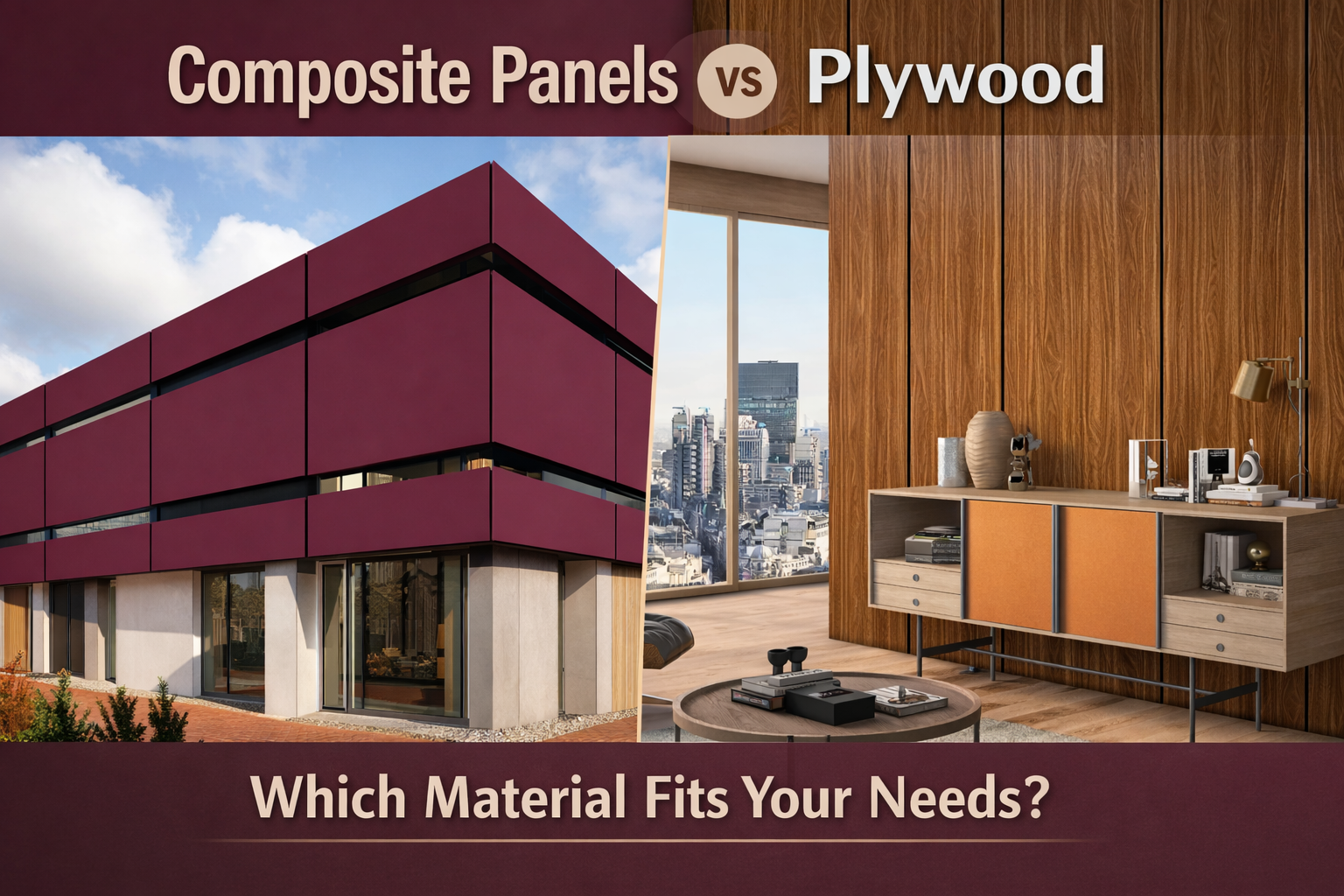
Selecting the right material is one of the most important decisions in any interior or exterior project. Whether you’re designing furniture, cladding walls, building partitions, or creating architectural surfaces, two commonly considered options are composite panels and plywood.
While plywood has been a long-standing favourite in construction and carpentry, modern composite panels — particularly Aluminium Composite Panels (ACP) — have emerged as a versatile, durable, and design-forward alternative.
This guide compares composite panels and plywood across performance, durability, aesthetics, cost, and application suitability to help you determine which material best fits your needs.
Composite Panels vs Plywood: Comparison
| Feature | Composite Panels | Plywood |
| Material Type | Engineered multi-layer panel | Engineered wood |
| Durability | Very high | Moderate |
| Moisture Resistance | Excellent | Limited |
| Weather Resistance | Excellent (exterior grade) | Poor (outdoor exposure) |
| Termite Resistance | Yes | No |
| Maintenance | Low | Requires polishing/lamination |
| Finish Options | Wide variety (metallic, wood, stone, etc.) | Limited without laminates |
| Weight | Lightweight | Heavier |
| Structural Strength | Not load-bearing | Good load-bearing |
| Installation | Fast & clean | Traditional carpentry |
| Lifespan | 15–25+ years | 10–15 years |
| Best For | Cladding, façades, interiors | Furniture, cabinets, structure |
Understanding the Materials
What Is Plywood?
Plywood is a traditional engineered wood product made by bonding thin layers (veneers) of wood together under heat and pressure. The grains are typically arranged in alternating directions to improve strength and stability.
Common Uses:
- Furniture
- Cabinets
- Doors
- Partitions
- Structural frameworks
What Are Composite Panels?
Composite panels are multi-layer engineered sheets made by combining different materials to enhance performance. One of the most popular types in architecture is the Aluminium Composite Panel (ACP), consisting of two aluminium sheets bonded to a core material.
Common Uses:
- Façades
- Wall cladding
- Ceilings
- Signage
- Furniture surfaces
- Partitions
Composite Panels vs Plywood: Key Differences
1. Durability
Plywood:
- Durable under controlled indoor conditions
- Vulnerable to moisture, swelling, and warping
- Prone to termite and fungal attacks
- Requires polishing, laminates, or veneers for protection
Composite Panels:
- Resistant to moisture, UV, and corrosion
- No termite or pest damage
- Does not warp, crack, or delaminate easily
- Designed for long-term performance
Verdict:
Composite panels offer superior durability, especially in challenging environments.
2. Weather & Moisture Resistance
Plywood:
Even marine-grade plywood can deteriorate over time when exposed to humidity or water unless properly sealed.
Composite Panels:
Engineered specifically for exterior and high-humidity applications. They maintain structural stability even in rain, heat, and coastal climates.
Verdict:
Composite panels clearly outperform plywood outdoors.
3. Maintenance
Plywood:
- Requires polishing or lamination
- Periodic refinishing needed
- Susceptible to scratches and stains
Composite Panels:
- Easy to clean
- No repainting or polishing
- Resistant to fading and surface damage
Verdict:
Composite panels are low-maintenance.
4. Aesthetic Flexibility
Plywood:
- Natural wood appearance
- Limited finish options without additional laminates/veneers
- Customisation increases cost
Composite Panels:
Available in:
- Solid colours
- Metallic finishes
- Wood textures
- Marble & stone effects
- Brushed and matte finishes
- Mirror & speciality surfaces
Verdict:
Composite panels provide unmatched design versatility.
5. Structural Strength
Plywood:
- Strong load-bearing capacity
- Suitable for frameworks and furniture structures
Composite Panels:
- Excellent rigidity for cladding and surfaces
- Not typically load-bearing
- Used as a finishing/cladding material
Verdict:
Plywood wins for structural applications.
6. Weight
Plywood:
Heavier, especially in thicker grades.
Composite Panels:
Lightweight yet rigid, reducing transportation and installation load.
Verdict:
Composite panels are easier to handle and install.
7. Installation & Fabrication
Plywood:
- Easy to cut, nail, screw
- Requires finishing layers
- Labour-intensive polishing/lamination
Composite Panels:
- CNC routable
- Bendable/formable
- Faster façade installation
- Cleaner, modern detailing
Verdict:
Composite panels offer faster, cleaner installations for cladding.
8. Lifespan
Plywood:
Typically 10–15 years depending on quality and maintenance.
Composite Panels:
15–25+ years with minimal maintenance.
Verdict:
Composite panels last longer.
9. Cost Considerations
Initial Cost:
- Plywood may appear cheaper initially
- Composite panels cost more per sheet
Lifecycle Cost:
Plywood requires:
- Lamination
- Veneers
- Polishing
- Repairs from moisture/termite damage
Composite panels require:
- Minimal maintenance
- No polishing
- Lower repair costs
Verdict:
Composite panels often deliver better long-term value.
Best Use Cases
Choose Plywood When You Need:
- Structural strength
- Furniture framework
- Cabinets & joinery
- Load-bearing surfaces
- Traditional carpentry work
Choose Composite Panels When You Need:
- Exterior cladding
- Moisture resistance
- Modern finishes
- Lightweight materials
- Low maintenance
- Premium aesthetics
- Interior feature surfaces
Performance in Modern Architecture
Modern construction increasingly favours materials that combine aesthetic appeal, durability, and efficiency. Composite panels excel in:
- Contemporary façades
- High-rise cladding
- Retail & corporate interiors
- Decorative partitions
- Ceilings & columns
- Signage systems
Plywood remains essential for core structural and furniture elements but is increasingly paired with composite panels for finishing.
Sustainability Considerations
Plywood:
- Wood-based, depends on forestry practices
- May involve adhesives and treatments
Composite Panels:
- Aluminium is recyclable
- Long lifespan reduces replacement waste
- Eco-friendly manufacturing options available
- Both materials can be sustainable when sourced responsibly.
Final Comparison
| Requirement | Better Choice |
| Structural strength | Plywood |
| Exterior durability | Composite Panels |
| Moisture resistance | Composite Panels |
| Design flexibility | Composite Panels |
| Maintenance | Composite Panels |
| Traditional furniture | Plywood |
| Modern façades | Composite Panels |
Conclusion
There is no universal “better” material — only the right material for the right application.
- Plywood remains unmatched for structural and carpentry-based applications.
- Composite panels lead in durability, aesthetics, weather resistance, and modern architectural design.
In today’s projects, the smartest approach is often combining both: plywood for structure, composite panels for finish, protection, and visual impact.